
At study programme level
It is important that quality assurance work has a foundation in the study programme committee to ensure participation and dialogue. At the same time, the work must be clearly managed by a study programme coordinator. The study programme director’s report operationalises goals and sub-goals in the quality assurance system and ensures reflection at several organisational levels.
Brief information about quality assurance work at study programme level

The figure shows the main processes in the quality assurance work at study programme level:
- Each study programme is led by a study programme director who chairs the study programme committee. The students are represented on this committee.
- All courses must have a course evaluation. Each course in the study programme is led by a course coordinator. The course coordinator uses the evaluation and other experiences from the completion of the course to write the course coordinator’s report. The quality assurance work at course level is described on a separate webpage.
- The study programme director uses the reports from the course coordinators and key figures for the study programme to prepare the study programme director’s report. This is processed in the study programme committee before it is submitted to the faculty management.
These processes form a standard model that must be followed in the quality assurance work for the individual study programmes. The model is essentially the same for all study programmes, but adaptations are required to achieve the quality assurance work objectives in certain programmes:
Study programme committees
Function
Study programme committees must be established in all study programmes. The committee is an advisory body for the study programme director. The committee acts as a driving force behind the further development of educational quality. The committee is chaired by the study programme director and meetings normally take place twice each semester and consist of the study programme director, course coordinators associated with the programme and student representatives from all cohort.
In special cases, the composition of the committee can be adapted to the nature of the study programme and approved by the dean. In relation to small and short-term study programmes, the objectives can be achieved through a simpler organisation. The main objective is for student voices to be heard and taken seriously in a structured and open arrangement.
The study programme committees adress the following matters:
- Planning and follow-up of student evaluations of the study programme and courses
- Follow-up of key evaluations at study programme level
- Revision of course and study programme descriptions
- Learning environment and social measures in the study programme
- The study programme director’s annual quality assurance report to faculty management
- Other issues that students and/or others consider important in their work on educational quality.
Minutes of the meetings are approved by those present, both student representatives and employees. The minutes shall be archived in the quality assurance system’s file archive in the faculty’s Canvas room. This file archive has separate folders for the individual study program and the minutes shall be made available for the students at the program.
The minutes are also considered archiveworthy and must therefore also be archived in P360 according to a separate routine (NO).
Annual cycle
Relevant content at the meetings depending on the time of year:
- First meeting in the autumn: Review of the previous year’s evaluation summaries. Planning and follow-up of course evaluations, planning of the committee’s meetings throughout the year.
- Meeting in November/December: Review of the Start of Study Year Survey, study programme director’s report,
- Meeting in early February: Review of national Student Survey,
- Meeting late in the spring semester: Review of key figures for the study programme, revision of course descriptions and programme descriptions, follow-up of the study programme director’s report.
Templates and resources
Study programme director
Areas of responsibility
The study programme director has day-to-day responsibility for the educational quality and for the quality assurance work on their respective study programmes.
Duties
In connection with quality assurance work, the study programme director has the following duties:
- Normally twice a semester, convene and chair the study programme committee. See also the committees annual cycle. The study programme director is also responsible for ensuring that minutes are taken at the meetings. Approved minutes must be distributed in the specified manner and attached to the study programme director’s report.
- Ensure that the study programme evaluations are appropriate and carried out in accordance with the dean’s approval. The study programme director must use the discussions that take place in the study programme committees to make proposals to the dean regarding the design of evaluation routines in the programme of study.
- Responsibility for ensuring that student representatives are elected. This may be delegated to course coordinators/programme coordinators/teachers who ensure that representatives and deputies from all cohorts of the study programme are elected. Elections of student representatives must be held within two weeks after the start of the semester.
- Responsibility for implementing improvement measures during the teaching year (includes improvement measures that are decided at faculty level).
- Responsibility for facilitating and initiating further development of the study programme, including initiating/facilitating new programmes or revising existing programmes.
- Write the annual study programme director’s report
- Plan and lead academic meetings to further develop the study programme.
INN has developed a separate role description for the Study prgramme director, which addresses the responisibilities and duties of the role.
The study programme director’s report
Brief information about the study programme director’s report
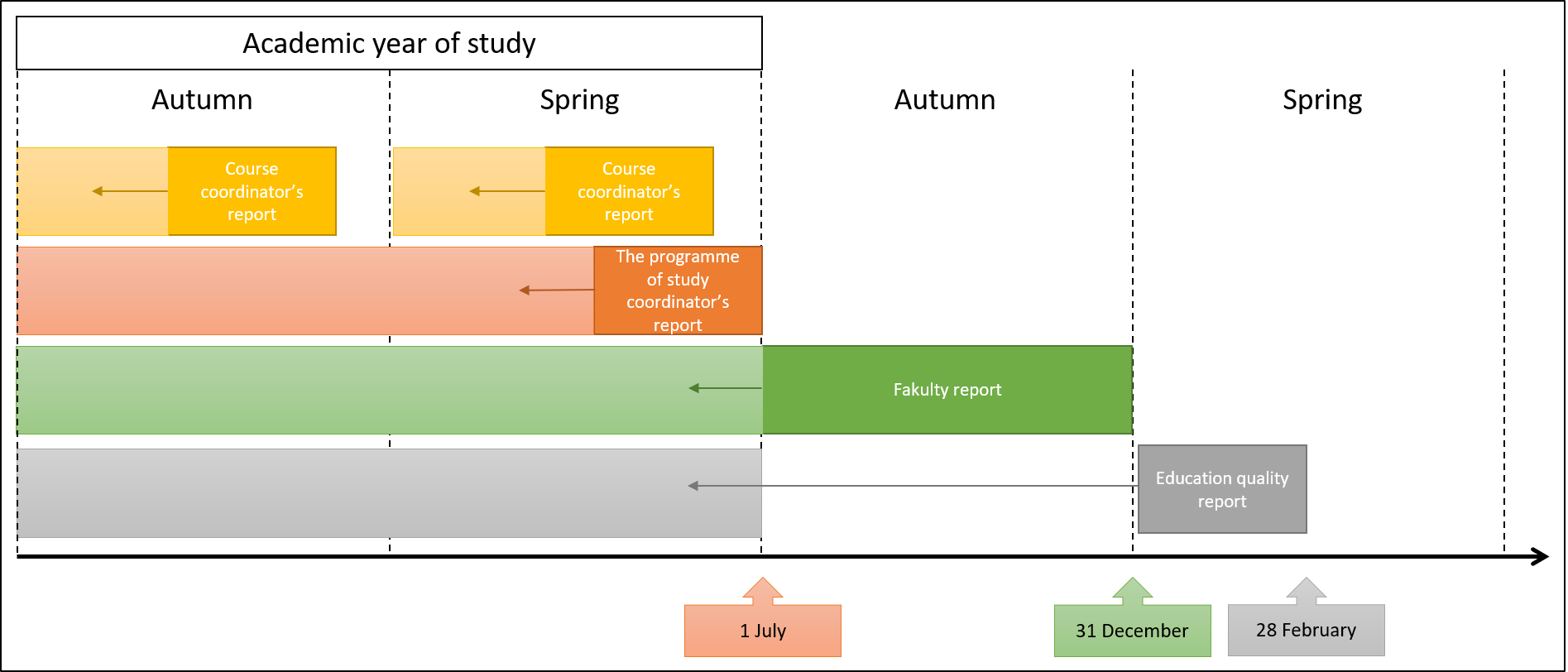
- Deadline: July 1st, however faculties may set their own deadlines
- Period: The report is based on the previous academic year of study
- The report should be 4 to 8 pages long. It is natural that the scope varies according to the type of programme in question (one-year programme, BA, MA).
- The report is archived in P360 and sent for approval to the vice-dean for education at the programme's faculty.
- The report is made available in the quality assurance system’s file archive in the faculty’s Canvas room.
- Annual cycle
Formal requirements
The study programme director’s report must document the quality assurance work conducted at study programme level. The quality assurance work has two key requirements:
- The quality assurance work must be based on knowledge from various surveys and evaluations (course evaluations, Start of study year survey, national Student survey, candidate surveys and periodic programme of study evaluations), as well as other experiences gained from the study programme (Section 4-1 (4) of the Academic Supervision Regulations) .
- The quality assurance work is a continuous learning process that addresses a challenge, plans measures, implements them, evaluates and improves them, before re-implementing and possibly making new changes (Section 4-1 (5) of the Academic Supervision Regulations) .
The template for the study programme director’s report is general enough to accommodate different local approaches to this process, with these two key requirements as a framework.
Introduction to the process
The study programme director’s report assess the educational quality of the programme of study in the previous academic year. The report must be sent to the Vice-Dean for Education at your faculty by 1 July (the faculty may decide on another deadline). On this page, we have collected explanations and tools that you may find useful when writing the report.

The figure above shows the process we envision when working with the report in the various areas of quality.
- Below, we briefly explain what we mean by the different sub-points
- Below, under the heading ‘Study programme director’s report and the various areas of quality’, we have gathered a number of links to resource pages for the various areas of quality (Norwegian only). This is where we provide information about the goal structure, say more about relevant indicators and point to some relevant questions one can ask. Remember to always make a selection. What is most important for your study programme?
- Below, under the heading ‘Relevant templates’, you will find the template for the programme of study coordinator’s report. Under the heading ‘Resources’, you will find other resources that will provide you with data for your analysis.
Indicators
Quantitative indicators can give an overview of the state of the study programme. Each study programme recieves a report of the most important indicators, called the primary indicators report. An important reason why these indicators have been chosen is that they represent a form of ‘measurement’ that is usuable at programme of study level.
These indicators are one part of the overall picture and it is expected that they are used to say something about the development of the programme over time. All study programmes should have a relatively high awareness of these indicators.
In cases where the primary indicators report does not include data for a specific indicator, you should consider why this is so. Think about what this data will bring to the quality assurance work. Do you have other ways to highlight this in your study programme? Perhaps you can emphasise this in the course evaluations? Or is it perhaps the case that the study programme must motivate students so that they answer national Student survey and similar surveys?
Evaluation
The work on quality in education is a continuous process where we identify challenges, map needs and propose and implement measures. However, there is a danger that the process will stop there. New projects and challenges take up time and space and we forget to reflect on how the measure has actually worked. We need to learn from the experiences the measure has given us:
- What has worked?
- What hasn’t worked?
- Did the measure have any consequences that we didn’t think of?
- Did the measure have the effect we thought it would have?
- Was the measure implemented in a good way?
- Was it carried out as we thought it would be carried out?
- If it wasn’t carried out in the way we thought, why did it happen the way it did?
These and many more questions can be asked. The evaluation point in the report is an opportunity to highlight parts of the reflection we have made. Be aware of what you include!
- What are the most important experiences we have had?
- What experiences are important to highlight with regard to future measures?
The target group for the report is primarily the study programme, but evaluation of measures (Evaluation) is also useful for other study programmes, for faculty management and for the core sections of the university. Important experiences can help shape future seed funding announcements.
Situation description
It is important for us to emphasise that neither primary nor potential indicators will provide you with the full picture. This picture appears in full when the figures are seen in context with experiences from the classroom, with course evaluations and course coordinators’ reports as a backdrop, and discussed in the academic community, with the student administration and in the programme of study committees. The full picture is complex. Quantitative indicators and other information from various surveys, reports and conversations must be viewed in context in order to give a picture of the state of the programme of study.
We would like you to provide a brief description of this state under this sub-point. Below each area of quality, you will find a set of relevant questions that might help you by pointing to topics you can focus on in your analysis (please find links below (Norwegian only)).
Above all, we ask you to exercise the art of restraint. Choose what you consider to be most important. The choice itself indicates a prioritisation. Perhaps you will then be challenged on the programme of study committee regarding your choice? Or maybe the vice-dean will ask some questions? This in itself may result in a good discussion among the programme of study committee members, or with the vice-dean. What should we actually prioritise? The description should lead to measures, and remember that not everything can be accomplished every single time.
Needs
The situation description will most likely point to certain needs. We distinguish between challenges and needs. A challenge is something that we want to do something about. The challenges are found when we assess the indicators, listen to experiences, interpret evaluations and discuss together in the academic community, with the student administration and in the programme of study committee.
In order to meet these challenges, certain needs will arise. These are resources that we do not fully possess at the moment, and that we need in order to meet the challenge. Some of these needs can be satisfied internally in the programme of study. For example, one may apply for seed funding. Others require additional resources from the department or faculty.
This is not about the general needs you may have for resources in the programme of study. These are needs that are based on challenges you have described in the situation description and that you follow up when proposing measures. It is therefore very important that you link the needs with the challenge you outline. If these are needs that can only be satisfied with support from the department or faculty, it is important that you emphasise this clearly so that it is acknowledged by the right people.
Finally, it is important to emphasise that this point is not an opportunity to refrain from proposing measures. We all live in the relationship between the present and the perfect. Perhaps it is the case that major changes are not possible without the addition of resources? What about small changes?
- What can be done given the present situation?
- What can’t be done before extra resources are allocated?
Through such a process, we want to raise a constructive awareness that can stimulate productive discussions, both within the programme of study and between the different levels at the university.
Measures
We conduct quality assurance work to preserve or increase the quality of education. In order for this to happen, one must learn from experience, identify challenges and map needs, but it is equally important to initiate measures, and evaluate whether these have worked as intended. Here, we want you to specify the measures you want to introduce to meet the challenge. Next year, you will evaluate under ‘Reflection’ whether the measures have worked.
Relevant templates
- Template for the programme of study coordinator’s report
- Template for the course coordinator’s report
- Template for the faculty report (NO)
Tableau
- Tableau (login)
- Instructions on how to use Tableau (NO)
- Guide to indicators - study coordinator’s report 2023 (NO)
Quality assurance work as a continuous process
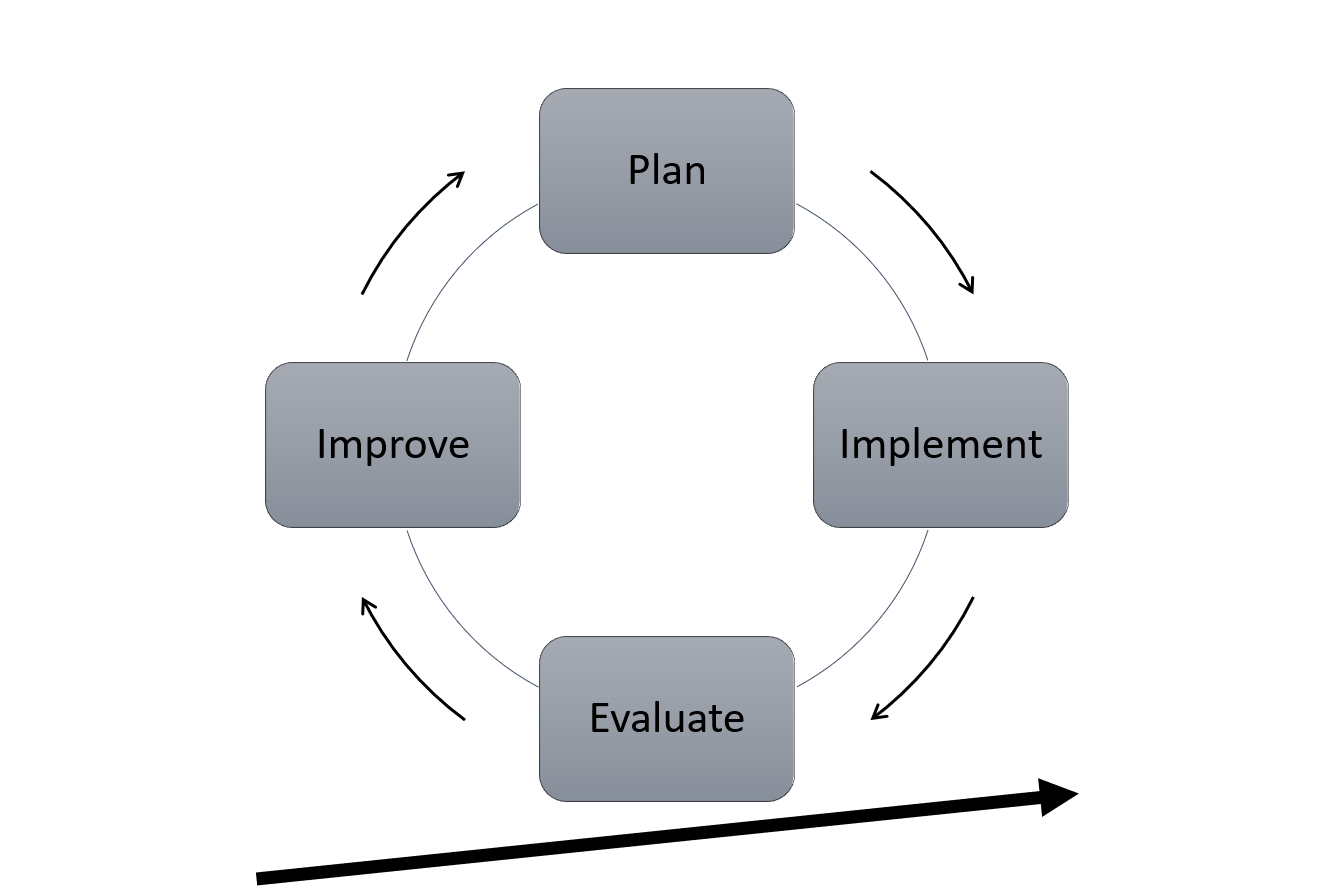
Quality assurance work in education is a continuous process, where the goal is to continue doing the things that work and improve the things that don’t work as well.
In order to do this systematically, we must be clear about what we wish to preserve or change and formulate concrete measures to meet this challenge. We have to plan well!
Once this is done, we haven’t even reached halfway. We have to implement the measures and we must evaluate the process. Maybe there is something we should improve on? Something that should be done a little differently?
The programme of study coordinator’s report is an important part of this process
The report plays an important role in the evaluation of what we have done (Reflection). It can also propose improvements and show how something can be done differently. This is done through a reflection process via a description of the situation and needs, and which ends with a proposal of measures. In this sense, the report should be part of the planning we do.
The report also has two other functions:
- It should stimulate a discussion between the programme of study committee members. This discussion should lead to the type of measures one wants to implement. Once the measures have been implemented, the committee should discuss the results.
- The report is also a way of telling the rest of the organisation how the programme of study is doing, the measures that have worked, the needs one has, and the measures one wants to initiate.