Master in Applied Biotechnology and Biomedical Sciences
A master's degree in biotechnology is a gateway to stimulating, challenging and lucrative jobs within a rapidly growing bioeconomy. You can contribute to smart solutions that secure future sustainable development, and become eligible for admission to various PhD programmes.
- Campus
- Hamar
- Duration
- 2 years
- Structure
- Full time
- Credits
- 120
- Teaching language
- EN
- Startup
- August
- Price
- Semester fee
- Application deadline
- Dec. 1, 2026
- Application deadline
- Apr. 15, 2027
About the Programme
This field of science is at the forefront of crafting sustainable solutions for the impending bioeconomy, with a dedicated focus on enhancing food production, healthcare, and environmental stewardship.
In the first year of our master's degree programme, students engage in coursework at the master's level, immersing themselves in our primary areas of experimental interest. These encompass areas such as cellular and reproductive biotechnology, molecular and functional genetics/genomics, bioinformatics, and biodiscovery. Notably, this comprehensive curriculum also includes a course in biotechnology commercialisation, equipping students with a holistic understanding of the field.
To cater to students with a bachelor's in biomedical laboratory science (bioingeniørfag), we offer the flexibility to substitute up to two courses with alternative courses focused on laboratory medicine. This adaptability ensures that our master's programme accommodates diverse educational backgrounds, fostering a multidisciplinary approach in graduates who emerge adept at tackling multifaceted biotechnological challenges. As a result, our students are well-prepared to navigate the complex landscape of biotechnology with skill and expertise, making substantial contributions to the industry and to society.
Curricula and courses
In the study plan, you will find information about the study programme, including an overview of subjects, learning objectives and forms of assessment. Select the study plan for the year you started your studies to find the information that applies to you.
What can I be
You will be qualified for work in research, development, production and diagnostics laboratories, both nationally and internationally. The graduates are well-suited to work in public and private domains, including biomedical laboratories and biotech industries related to agriculture and aquaculture, food production, and pharmaceutic development.
In addition, public and private regulatory authorities as well as the consultancy industry also need people with a background in biotechnology.
Completing the MSc degree is a qualification for study at PhD level at INN or other Norwegian or international universities.
Application deadline and admission
Non-EU/EEA students: 1 December
EU/EEA students: 15 April
The application portal opens on 1 November for applicants outside the EU/EEA and Switzerland.
The application portal opens on 1 February for applicants inside the EU/EEA and Switzerland.
How to apply
Non-EU/EEA applicants
You will find the programme in the list of study options with application code 5458.
EU/EEA and Swiss applicants who do not have a Norwegian ID number
You will find the programme in the application portal under 'English-taught programmes' with application code 5460.
Applicants who have a Norwegian ID number
You will find the programme in the application portal under 'Master programmes' with application code 5461.
Admission requirements
The programme has the following admission requirement:
A completed degree equivalent to a 3 year Norwegian bachelor’s degree in biotechnology, biomedical laboratory science (bioingeniørfag), biochemistry, molecular biology, cell biology, bioscience, or similar. Your degree from higher education must fulfill the following requirements:
- The equivalent of at least 80 ECTS credits in natural sciences and mathematics, with a solid foundation in chemistry and biology.
- A course in Biochemistry, or a course in Molecular biology, each corresponding to at least 5 ECTS, must be included, with a minimum grade equivalent to D in the Norwegian grading system.
- A minimum average grade equivalent to D in the Norwegian grading system.
Students lacking molecular biology coursework may qualify for molecular biology thesis work by completing a bachelor-level molecular biology course at INN University within the first semester.
English language requirements
Applicants must document their proficiency in English at a specified level: You will find the list of accepted courses and minimum scores accepted here.
The English language requirements apply to all except applicants with completed higher education taken in the UK, Canada, Ireland, New Zealand, Australia or the Nordic countries, who do not require to document any additional language proficiency.
How much does it cost?
Students from countries outside the EU/EEA/EFTA are required to pay tuition fees.
See information about tuition, and the fees for each individual programme here.
Applicants from outside the EU/EEA are required to provide proof of funding as part of their application.
This does not apply to students from the EU/EEA/EFTA.
You must also pay a semester fee.
Student exchange
The biotechnology master's study programme is entirely taught in English, allowing for international and local applicants. The entire curriculum is in English. The students are recruited globally, resulting in an international student environment. Natural science is an international-oriented subject. The professors at the department engage in international collaborations and the students are invited to contribute to these collaborative projects. If relevant for the master thesis and ongoing research projects, students may visit international research collaborators. It can also be possible to travel on an exchange abroad as part of the master's study.
Why study Master in Applied Biotechnology and Biomedical Sciences
The Hamar region constitutes an agro-industrial hub, including major animal and plant breeding companies, high-tech spin-off enterprises and chief companies in the food and feed industries. The biotech group at Inland Norway University of Applied Sciences collaborates closely with industry, and an essential part of our biotechnology research stems from relevant industrial strategies and problems.
Contact us
If you have questions about applications and admission requirements, you can contact our admissions office at admission@inn.no or telephone 62 43 00 04.


Student stories
-
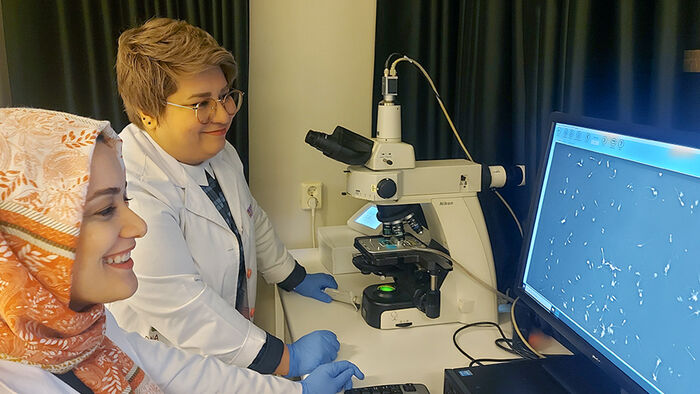
Everyday life in the lab Mar. 8, 2023 10:55 PM
They came to Norway from Iran to take a master's degree in biotechnology. Now they are part of a large research project.
-
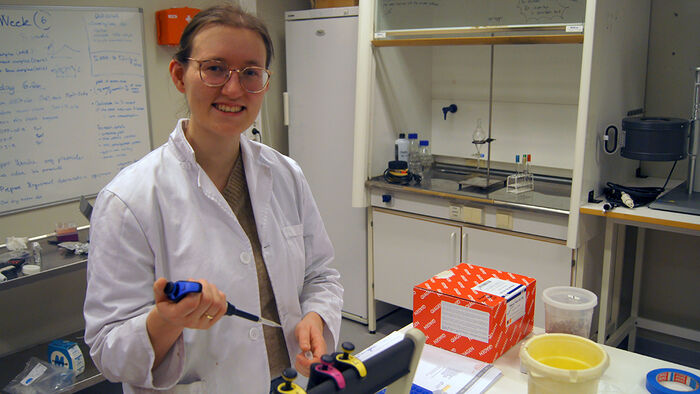
Why choose biotechnology? Mar. 8, 2023 11:56 PM
After completing the programme, Sarah aims for practical work within biology to create future-oriented solutions. A master's degree in commercial biotechnology provides her with the necessary expertise.