
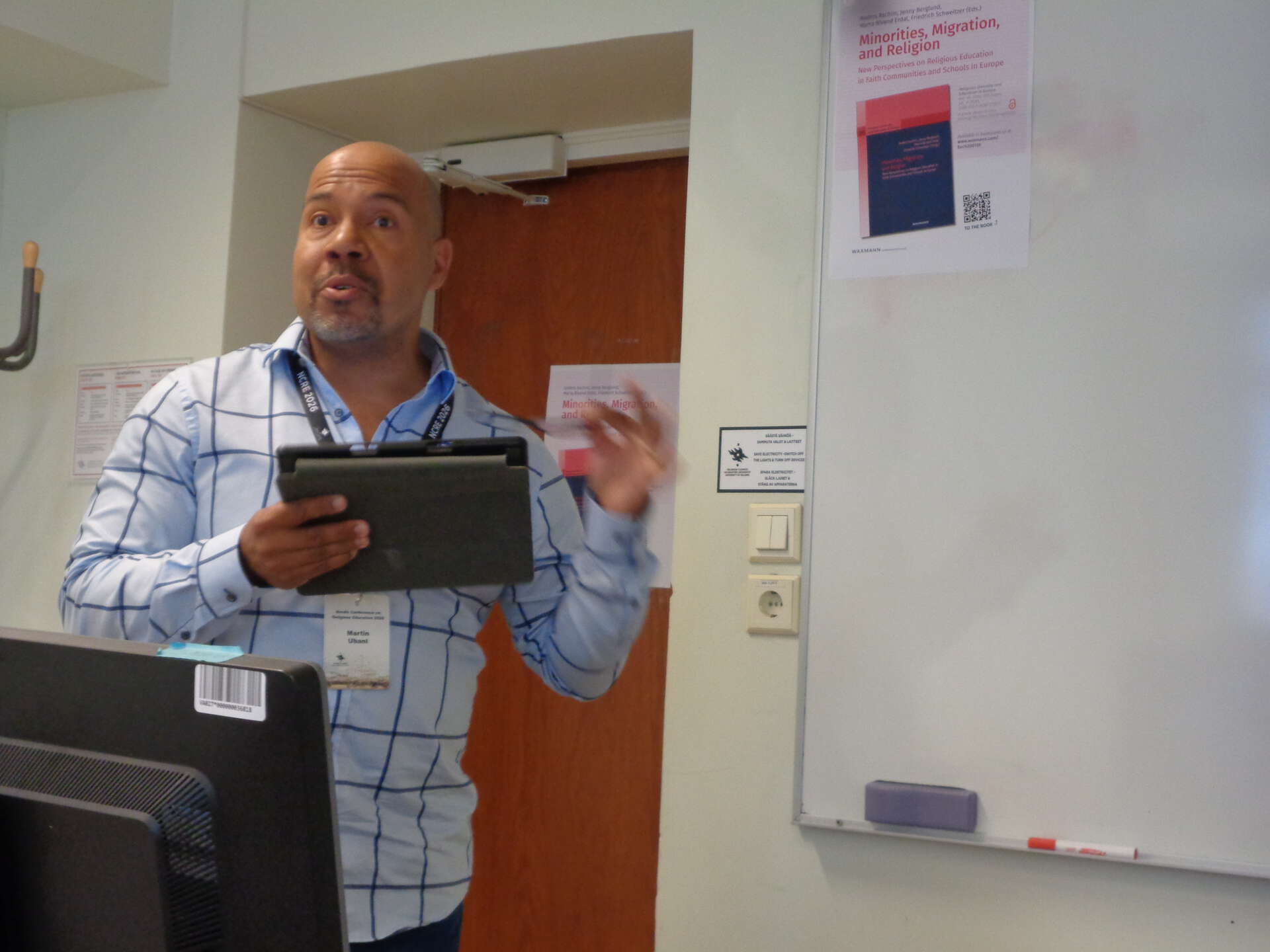
A symposium "Between faith community and school: Minorities, migration, and religious education" took place at the NCRE conference on Wednesday 10 June, celebrating the publication (online, open access) of the volume Minorities, Migration, and Religion: New Perspectives on Religious Education in Faith Communities and Schools in Europe (Waxmann Verlag).
Project manager and editor Anders Aschim (University of Inland Norway) introduced the project Non-formal faith education, the public school, and religious minorities in Norway (FAITHED) for colleagues from the Nordic countries, emphasizing the internal "superdiversity" of the minorities studied. "Superdiversity" was one of the conference's main themes.
 |  |
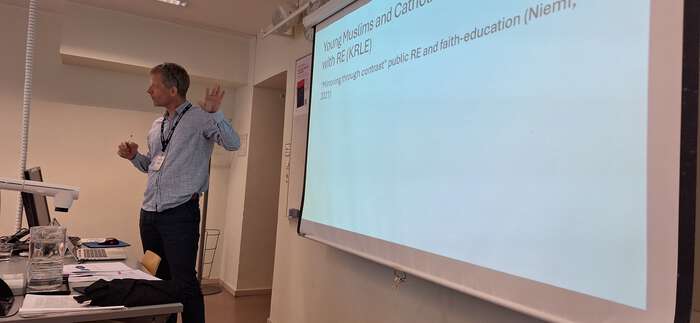
Hildegunn Valen Kleive (Volda University College) discussed some dimensions of Islamic and Catholic faith education, based on findings from the FAITHED project, and Ole Kolbjørn Kjørven (University of Inland Norway) presented young Muslims' and Catholics' experiences with public RE.
The volume also contains chapters related to other European contexts than the Norwegian, most of them written by members of the project's Advisory Board. Jenny Berglund (Stockholm University), board member and co-editor of the volume, presented the chapter she has co-written with her Polish colleague Konrad Pędziwiatr, "Learning Islam Within the Formal School System: Experiences from Poland and Sweden". They demonstrate interesting contrast: Islam has a seven centuries-long history in Poland, versus seven decades in Sweden. In Swedish public school, all students learn about Islam in the non-confessional and mandatory subject "Religionskunskap". The few Muslim students in Polish schools receive religious education according to their own religious tradition.
Professor Martin Ubani (Itä-Suomen Yliopisto/University of Eastern Finland) commented on the book and the presentations. His response was very positive, but he also raised the important question "So what?" that sparked an interesting discussion with the audience on the significance of the findings, in particular concerning school and teacher education.