

Project goals
Building a knowledge base for sustainable, carnivore-compatible livestock production that enhances biodiversity and ecosystem services of the boreal forest.
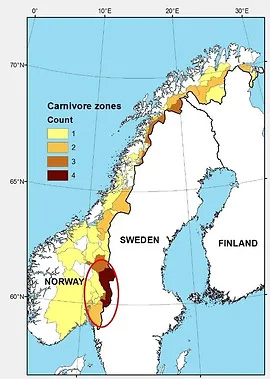
Norway has committed to ensuring viable carnivore populations as well as sustainable livestock production. The outfields are an important grazing resource for many livestock producers. Sheep and cattle are often free-ranging in the subalpine areas and forests during the summer months. To avoid livestock losses to carnivores, zoning is used as a measure to separate livestock and carnivores.
For each of the four large carnivore species, brown bear, wolf, lynx and wolverine, there are designated breeding zones, while other zones are prioritized for free-ranging livestock grazing on outfields. However, using zoning in carnivore management is challenging, as carnivores often use large home ranges that do not align with the zone borders, and young carnivores disperse into the zones prioritized for grazing, causing high losses each year. Within the wolf zone, livestock production based on outfield grazing has decreased or even ceased completely. The establishment of carnivore zones is sometimes conceived as an undemocratic, top-down process, and there is considerable resistance within the resident population against the continuation of the zones, not only due to the limitations to livestock production, but also other conflicts related to the return of the carnivore populations in Norway.
Livestock grazing in outfields has a long tradition in Norway, and during the past 2000 years, cattle and sheep were the dominant large herbivores in many forest and mountain areas. Grazing and haymaking have created plant communities characterized by shade-intolerant grasses and herbs and a rich fauna of invertebrates. Floral abundance and diversity on such semi-natural grasslands favor pollinating insects, which in turn are key species for ecosystem functioning and food production.
However, many of these species have experienced a rapid decline in the past decades, partly caused by ceased livestock grazing and partly by intensified grassland management. In the Norwegian Red List, 29% of all threatened species are thought to be negatively affected by ceased grazing or haymaking. The loss of species-rich semi-natural grasslands contributes strongly to the global decline of biodiversity, and Norway is no exception. Norwegian studies on the effects of outfield grazing on biodiversity are pre-dominantly from subalpine regions, and to our knowledge, the relationship between grazing and biodiversity in commercial boreal forests has not been subject to study so far.
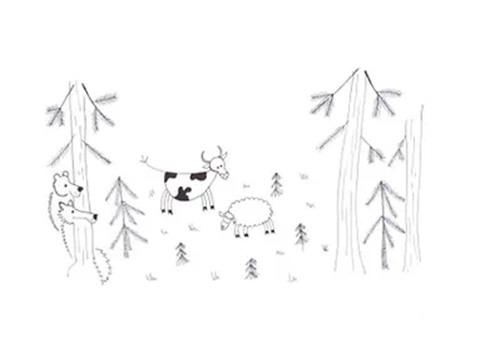
In spite of Norway’s political decision to separate outfield-based livestock production from carnivore recovery areas, the population ranges of large carnivores have a large potential for sustainable livestock production as well as forestry, in line with Norway’s goal to increase livestock production in the outfields and in support of the national pollinator strategy. This can be achieved by having cattle rather than sheep free-ranging in the forest. Smaller livestock needs to be protected with carnivore-proof fences. Both measures are realized in some areas, but they are poorly evaluated with regard to depredation risk, biodiversity and timber production. There is a large need for knowledge on how livestock production in the forested carnivore zones can successfully trigger local and regional economy while ensuring carnivore conservation and ecosystem services, such as forestry, pollinator diversity and game harvest.
Our project "Grazing in Carnivore Forests" studies the potential of using carnivore-exposed forests in south eastern Norway for livestock grazing in combination with forestry and large game hunting, while taking into account biodiversity of plants and pollinators.
Work packages
- WP1: Free-ranging cattle - Assessing compatibility with carnivores
- WP2: Fenced sheep - Evaluation of large enclosures
- WP3: Biodiversity and forest recruitment
- WP4 - Implementation
Publications
Beyene, S. M., Naumov, V., & Angelstam, P. (2024). Long-term dynamics of grasslands and livestock in Norwegian cultural landscapes: implications for a sustainable transition of rural livelihoods. Landscape Ecology, 39(9), 171.
Forti, A., Lissillour, P., Eriksen, A., Cerjak, B., Campon, C., Motlova, S., ... & Zimmermann, B. (2024). Carnivore exclosures to protect sheep affect the distribution of a wild cervid. Wildlife Biology, e01301.
Niccolai, L. J., Devineau, O., Thiel, A., Zimmermann, B., & Evans, L. A. (2024). Connecting the dots: relationship between heart rate and overall dynamic body acceleration in free-ranging cattle. Conservation Physiology, 12(1), coae085.
Spedener, M., Mathisen, K. M., Hauer, J., Hérault, R., Austrheim, G., Tofastrud, M., & Zimmermann, B. (2024). Effects of cattle grazing on young spruce trees in boreal production forest. Trees, Forests and People, 100596.
Spedener, M., Tofastrud, M., Austrheim, G., & Zimmermann, B. (2024). A Grazer in a Browser's Habitat: Resource Selection of Foraging Cattle in Productive Boreal Forest. Rangeland ecology & management, 93, 15-23.
Spedener, M., Valaker, J., Helbert, J., Schubert, V., Mathisen, K. M., Henriksen, M. V., Nielsen, A., Austrheim, G., & Zimmermann, B. (2024). Effects of cattle and cervids on plants and flower-visiting insects in young spruce plantations. Forest ecology and management, 572, 122258.
Spedener, M., Tofastrud, M., Devineau, O., & Zimmermann, B. (2019). Microhabitat selection by beef cattle on summer pasture in boreal forest. Applied Animal Behaviour Science.
Tofastrud, M., Møllevold, O. H., & Zimmermann, B. (2025). Forage quality, road and stocking density influence the home range size of free-ranging beef cattle in the boreal forest. Applied Animal Behaviour Science, 282, 106455.
Versluijs, E., Niccolai, L. J., Spedener, M., Zimmermann, B., Hessle, A., Tofastrud, M., Devineau, O., & Evans, A. L. (2023). Classification of behaviors of free-ranging cattle using accelerometry signatures collected by virtual fence collars. Frontiers in Animal Science, 4, 1083272.
Versluijs, E., Tofastrud, M., Hessle, A., Serrouya, R., Scasta, D., Wabakken, P., & Zimmermann, B. (2024). Virtual fencing in remote boreal forests: performance of commercially available GPS collars for free-ranging cattle. Animal Biotelemetry, 12(1), 33.

- barbara.zimmermann@inn.no
- Phone
- +47 62 43 08 70