
Trauma-informed teaching
This guide supports EMERGE partner institutions in developing and delivering workshops for academic staff on trauma-informed teaching in higher education.
Part I: Conceptual foundations
Why trauma-informed teaching education is needed at higher education institutions
As higher education institutions across Europe seek to widen participation among students from a greater variety of backgrounds, there is a growing need for awareness of, and skill in, working with students who face difficult circumstances, whether in their past or in their present. National access and participation plans differ from country to country, but most identify similar underrepresented groups: students from socioeconomically disadvantaged backgrounds, members of ethnic minority and migrant communities, and students with disabilities. Each partner institution will recognise its own equivalent among them.
This is a welcome development, but it also means that a greater number of students may be carrying difficult experiences into the classroom. It is important to understand that students who have experienced marginalisation or disadvantage are more likely to have encountered trauma before they reach university. Trauma is not, however, confined to any one group: since we can never be fully aware of anyone's history, it is safest to assume that, in any class, some students may be affected.
The wider evidence supports this. A 2024 survey of more than 200,000 students across 25 European countries found that poor well-being was widespread — in many countries reported by the majority of students — and closely related to financial pressure, discrimination, isolation, and a low sense of safety on campus (Hauschildt, 2024). Not all of this distress stems from trauma, but the pattern is clear, and the heaviest burden tends to fall on those students who are already most marginalised.
For teaching staff, this carries a practical implication. A trauma response that is not recognised, or that is not appropriately addressed in the classroom, can deepen a student's distress and lead to retraumatisation and further marginalisation. How educators respond, in other words, makes a real difference. Yet while a wealth of resources exists to support trauma-informed teaching at primary and secondary level, comparable material for third-level education remains scarce, and staff are rarely trained for this aspect of their work. It is this gap that the present workshop seeks to address.
Educators need not have a background in psychology to teach in a trauma-informed way. The workshop offers a working understanding of what trauma is and how it affects learning, support in recognising a trauma response when it arises, and a set of practical, realistic measures that staff can take — and pitfalls they can avoid — in order to support students and prevent harm. All our resources can be accessed at this website also: https://www.trauma-sensitive-teaching.org.
Defining trauma
The word "trauma" comes from the Greek for "wound," and this is a useful place to begin: trauma is best understood not as a difficult event in itself, but as the inner injury that such an event can leave behind — "a lasting rupture or split within the self" (Maté 2022). It is important to understand that the same event may affect two people quite differently, and that what matters for our purposes is not the event but its lasting imprint on the person.
This imprint is at once psychological and physical. Trauma lodges in the nervous system as well as in the mind, and its effects are therefore often involuntary, persisting long after the original experience and triggerable at any moment. They tend to sit somewhere on a wide spectrum, ranging from hypervigilance and a constant state of arousal at one end to numbness, withdrawal and avoidance at the other, and over time they can wear a person down physically, mentally and emotionally.
Trauma is also commonly associated with childhood, but its effects do not stop there. Students may carry them into adulthood and into their academic lives, where they can shape the ability to trust and form relationships, to concentrate and remember, to regulate emotion, and to engage with learning. What is more, trauma is pervasive: because of our interconnectedness, it affects not only those who have directly experienced it but also those around them (Le Pichon & Lundy, 2023; Hunter, 2022).
Educators are not expected to — and indeed should not — diagnose students or respond to particular mental health indicators. What is needed, rather, is enough understanding of trauma to support students' learning and to avoid causing further harm in the form of retraumatisation or secondary trauma.
Categorising trauma
Trauma is commonly categorised in two broad ways. The first distinguishes simple or acute trauma, which arises from a single incident, from complex or developmental trauma, which builds over time. The distinction matters for educators because the two tend to call for different responses. Where trauma is simple and acute, early intervention — in families, in schools, and indeed in universities — can do much to prevent lasting effects such as post-traumatic stress, which is why raising awareness of it is itself a form of timely support. Complex trauma, by contrast, tends to have more enduring consequences, which may become woven into a young person's sense of identity and history, and which can show themselves in a wide range of somatic, cognitive, emotional, social and behavioural ways.
The second distinction concerns the kind of event involved. Trauma is often associated with specific, identifiable and overwhelming events — sometimes called "Capital-T" trauma — but it is important to understand that it may equally arise from experiences that appear quite ordinary. This "small-t" trauma can follow from such things as bullying, repeated harsh comments, or the absence of sufficient emotional connection with a caring adult, which Maté describes as "good things not happening to a child" (2022). Whether an adverse experience becomes traumatic depends on a combination of factors: the nature and severity of the event, the meaning the person attaches to it, the support available to them, and their own resilience (Bodfield & Culshaw, 2024).
It follows that trauma cannot be judged by the apparent gravity of an event. The same experience may leave lasting effects on one person and not on another, and it is therefore safest to bear in mind that any student may be affected. Trauma is, in the end, an individual matter, measured not by what happened but by what it has come to mean for the person who carries it.
Further resource. Staff who would like a fuller, clinically grounded account may wish to watch the two short video lectures by Prof. Lars Lien (Inland Norway University) on the project's "Understanding trauma" page (www.trauma-sensitive-teaching.org/understanding). In the first, Prof. Lien sets out what is meant by trauma; in the second, he explains how it can affect the brain. The videos are freely available, and as they run longer than the session itself allows, they are best shared with participants as follow-up material after the workshop rather than viewed during it.
Nervous system approaches to trauma
In recent years, trauma research has turned increasingly to the role of the nervous system, and in particular to the way it continually scans the environment for cues of safety or of threat — a process Porges terms "neuroception" (Porges, 2021). This work is most often associated with Polyvagal Theory, which offers a framework for understanding how the nervous system shapes our physiological responses, our emotional resilience and our capacity for social engagement (Porges, 2025).
For educators, the central insight is a reassuring one: a trauma response is not a choice, an attitude or a failure of will, but an automatic, whole-body reaction. After trauma, the nervous system can begin to misread ordinary situations as dangerous, so that a person remains anchored in a defensive state — on constant alert, anxious, or shut down and numb — even when no real threat is present. Understanding trauma in this way helps to explain why a student might react as they do, and, just as importantly, it points towards practical ways of helping a student to settle in a moment of crisis. For these reasons, the resources presented below are shaped throughout by insights from this approach.
A model that makes these ideas usable in the classroom is the Window of Tolerance (Siegel, 1999, 2012; Corrigan et al., 2011). It pictures our states as three zones. The middle zone — the window itself — is the range within which we can experience emotion of varying intensity while remaining balanced, calm, safe and focused; it is the zone in which a student is able to learn. Above it lies a zone of hyperarousal, in which the body mobilises into "fight or flight": its energy-consuming systems ramp up, and a person overwhelmed by anxiety, anger, panic or racing thoughts may feel out of control. Below it lies a zone of hypoarousal, in which the body does the opposite and begins to shut down — a "freeze" state, brought on by dread or exhaustion, in which a person may feel numb, paralysed or disconnected.
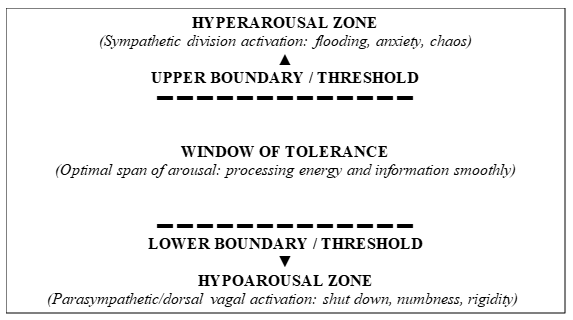
Adapted from The Developing Mind: How Relationships and the Brain Interact to Shape Who We Are (2nd ed., p. 278), by D. J. Siegel, 2012. Guilford Press.
The value of this model is that it maps directly onto what we might see in a classroom. For someone who has experienced trauma, the window may be narrow: such a student may find it harder to tolerate emotional or physiological arousal without being tipped into hyper- or hypoarousal, and may take longer to return to the middle zone once there.
It is important, however, not to treat the window as fixed, or to expect a given student to react in a particular way because of their history. As Siegel notes, the width of a person's window is not static; it shifts with their state of mind, the emotional charge of the moment, the social setting, the people present, and above all the degree of safety they feel. For educators, this is where the model becomes a tool for prevention as much as for recognition: it points to the conditions under which a student is most able to stay within their window, and so to remain available for learning.
Further resource. Prof. Lars Lien's second short video, on how trauma can affect the brain, on the project's "Understanding trauma" page (www.trauma-sensitive-teaching.org/understanding), complements this section. As with Part 1, it is freely available and best shared with participants as follow-up material after the session.
Common trauma responses
Where the previous section described these states from the inside, this one is concerned with how they appear from the outside — with the signs an educator is actually in a position to notice. The two zones beyond the window tend to reveal themselves in opposite ways.
A student in hyperarousal is visibly mobilised. We may see emotional outbursts or over-reactions — often to loud noises, sudden movements, physical contact or bright light — together with restlessness, impulsive or unpredictable behaviour, a readiness to take offence, or aggression towards others or themselves. Such a student may seem to be on constant alert, as though scanning the room for danger.
A student in hypoarousal presents in almost the reverse manner, and is for that reason far easier to overlook. Rather than acting out, they withdraw: they may appear absent or vacant, slow to respond, and disengaged from the people and the task around them. The mind has, in effect, closed over, leaving little capacity to think, reflect or respond. It is important to attend to this state precisely because it is so quiet — it is all too readily misread as disinterest or laziness, when it is in fact the sign of a nervous system under strain.
Not all signs are visible in the moment. Over time, a trauma response may surface as general nervousness, disturbed sleep, moodiness, intrusive thoughts or a gradual social withdrawal, any of which can quietly erode concentration and memory; as Porges (2021) observes, our physiological state colours how we read the world, and can tilt a person persistently towards threat. How to respond to these states in the classroom is the subject of the resources presented below and on this website: www.trauma-sensitive-teaching.org.
This picture of how trauma manifests raises a more specific question for our purposes: what does it mean for students as learners? The following section turns to the ways in which traumatic experiences bear on the capacity to learn.
How does trauma impact learning?
The responses described above do not remain at the classroom door; they bear directly on a student's capacity to learn. It is important for staff to understand that the root of a behaviour may lie not in the situation immediately at hand but in a student's history, and that a reaction which appears disproportionate may be entirely proportionate to something the educator cannot see (McCloughry, 2024).
At its core, trauma is the absence of a sense of safety and connection — and these are the very conditions on which learning depends. A student who does not feel safe, or who feels disconnected from those around them, is poorly placed to take in and work with new material. Beyond this, trauma, and particularly chronic exposure during the early years, can affect attention, memory and cognition directly, reducing a student's ability to concentrate, to organise and process information, and to plan and solve problems. The effort this demands can in itself give rise to overwhelming frustration and anxiety.
The consequences for academic life are well documented at primary and secondary level, where trauma has been associated with lower and less consistent attainment, higher rates of absence, and increased dropout (Terrasi & deGalarce, 2017). There is no reason to suppose that these effects cease at the age of eighteen. Studies at third level have begun to reveal the same pattern: post-traumatic stress has been linked to poorer effort regulation and weaker academic outcomes among university students (Boyraz et al., 2016; Frazier et al., 2009).
What is more, this burden is not evenly distributed across the student body. Students from non-traditional backgrounds — among them first-generation students, members of minoritised communities, and those from low-income households — are both more likely to carry traumatic experience and more likely to encounter additional pressures at university, from financial strain to caring responsibilities and paid employment, which may leave them less able to engage fully with campus life (Hunter, 2022; Bodfield & Culshaw, 2024). Culture and identity, too, shape how an experience is felt and what it comes to mean. This uneven distribution is precisely why a trauma-informed approach speaks to the widening-participation aims with which the guide began.
If trauma undermines the very sense of safety and connection on which learning rests, the educator's task is to help rebuild it. It is to this — what a trauma-informed approach asks of us, and the principles that guide it — that we now turn.
What is trauma-informed teaching and practice?
A trauma-informed approach is best understood not as a clinical intervention, but as a way of working — an orientation that runs through how an institution teaches, supports and relates to its students. In the widely used formulation of the US Substance Abuse and Mental Health Services Administration (SAMHSA, 2014), a trauma-informed system does four things: it realises how widespread trauma is and how deeply it can affect people; it recognises its signs and symptoms; it responds by building this understanding into everyday policies and practices; and it actively seeks to resist re-traumatisation. Trauma-informed practice is thus more than a single technique; it is a sustained shift in how we work.
Crucially, it does not ask educators to become diagnosticians. As lecturers, we have no reliable way of knowing whether a particular behaviour is the result of trauma, of another difficulty, or simply of the pressures of the moment. We may notice signs over time — a decline in performance, missed classes, prolonged withdrawal — but we are not trained to diagnose a student, and nor should we be. The premise adopted for these materials is therefore a deliberately simple one: whatever our reading of the signs, we refrain from diagnosing and instead respond appropriately to the behaviour itself, whatever may lie behind it. This also means moving away from a medical model that makes support conditional on a label or a diagnosis (Bodfield & Culshaw, 2024).
It is worth being clear about what this approach is not. To be trauma-informed is, in a useful phrase, to be "safe, not soft" (Scott & Jenney, 2023): it does not mean lowering academic expectations or shielding students from challenge, but rather removing needless harm so that students are better able to meet that challenge. Education is not health or social care, and a trauma-informed approach does not ask lecturers to take on the role of counsellors. What it concerns is the climate of the classroom and the manner in which teaching is delivered.
In practice, the approach is commonly organised around a set of guiding principles (SAMHSA, 2014): safety; trustworthiness and transparency; peer support and connection; collaboration; empowerment, voice and choice; and attentiveness to cultural, historical and gender context. Each of these translates into concrete choices an educator can make — choices that the activities and resources in this workshop are designed to make tangible.
Finally, it is important to understand that trauma is pervasive and systemic. It does not affect the individual student alone, but implicates the whole learning community, including those who have not themselves experienced traumatic events (Le Pichon & Lundy, 2023). For this reason, a trauma-informed approach extends beyond students to staff — to our own awareness, our reflective practice, and indeed our own wellbeing (Bodfield & Culshaw, 2024).
Part II: Workshop guidance
Workshop aim: To support academic staff in recognising signs and symptoms of trauma in and outside the classroom. To teach academic staff first response mechanisms that will give them confidence in the case of a crisis, and to help staff reflect on curriculum design that will help with the prevention of trauma responses.
Duration: 90-120 minutes
Learning outcomes: By the end of the workshop participants should be able to:
- define and identify trauma;
- recognize ways in which students’ traumatic experiences may impact on their learning and behaviour;
- identify appropriate responses and/or resources for students who may have experienced trauma;
- practice a more inclusive curriculum design.
Workshop content and resources
Activity 1: Introduction and reflection
10 minutes
Invite participants to consider:
- Why do we need training in trauma-informed practice at the Higher Education level?
- What do you know about your students and their backgrounds?
Activity 2: Conceptual input
15–20 minutes
TIP Slide Deck, slides 1-13 (Appendix 1)
Introduce:
- trauma and categorisations of trauma;
- nervous-system approaches and the window of tolerance;
- common trauma responses
- how trauma can impact learning
Activity 3: Scenario analysis
20 minutes
See Appendix 2 and 3
Participants work in small groups. For each scenario discuss:
- What signs and symptoms can you identify in the student?
- What might be going on for the student?
- What would you be inclined to do, and what are you unsure about?
- What alternative response could be considered?
Appendix 2 provides a table with scenarios.
Activity 4: Responding to a student in crisis — practical input and grounding practice
20 minutes total
This activity has two parts: a short input on how to respond when a student is pushed out of their window of tolerance, followed by a brief grounding exercise that participants try for themselves.
Part A — Practical input
10 minutes
Using TIP Slide Deck slides 14–23 and the “Responding to trauma” page of the project website, introduce a few concrete first-response strategies:
- helping a student move back towards their window of tolerance through grounding;
- what to say once a student is calmer, and what to avoid in the moment;
- restoring a sense of choice and control;
- keeping a dual focus — attending to the distressed student while keeping the rest of the group steady;
- knowing the limits of your role, and how to signpost to your institution’s support services.
Where useful, refer back to the scenarios from Activity 3 — for instance, what a grounding-informed response to the student who left the seminar (Scenario 1) might look like in practice.
Part B — Grounding practice
10 minutes
Explain that grounding techniques help bring an over- or under-aroused nervous system back towards the window of tolerance, and that the best way to understand them is to try one.
Before beginning, offer a genuine choice: invite participants to take part, to adapt the exercise, or simply to sit quietly and observe. Note that some people find focusing on the breath or closing their eyes uncomfortable, and that opting out is entirely fine. Offering this choice is itself a small demonstration of the trauma-informed principle of choice and control.
Then read the following slowly, in an unhurried voice:
“Let your feet rest flat on the floor, and feel the chair supporting you. If it’s comfortable, let your gaze soften or lower — or keep your eyes open, whichever you prefer. Take a slow breath in… and a slower breath out. Now gently look around and silently name five things you can see. Then notice four things you can hear. Then three things you can feel — your feet on the floor, the chair, your hands resting. Take one more slow breath out, and when you’re ready, bring your attention back to the room.”
Allow a brief pause, then debrief (2–3 minutes): How did that feel? Which techniques might you use yourself before a difficult class, or gently suggest to a student? Close by emphasising that grounding is a way of helping in the moment — it complements, and does not replace, professional support.
Facilitator notes
Keep the exercise short and low-key; this is a taster, not a therapeutic intervention.
Your own calm, unhurried delivery is part of what helps — the same steadiness works with a student in distress.
Slides 14–23 offer further techniques (paced breathing, restoring choice) you can draw on or recommend.
Activity 5: Institutional reflection
15 minutes
Invite participants to consider:
- Which forms of trauma might we most likely encounter in our institution?
- Are there institutional practices that could unintentionally cause retraumatisation?
- What changes could prevent this?
Activity 6: Inclusive curriculum input
15 minutes
Speak to different ways of inclusive curriculum design in the planning, delivery and post-delivery stages. See slide deck 24-29 and website for further details and ideas.
Activity 7: Closing discussion
10 minutes
Ask participants to identify:
- one idea they will take away from the workshop;
- one practice they may reconsider;
- one action they could implement in their own teaching or supervision.
Adapting the workshop to local contexts
The conceptual principles presented in this guide are intended to provide a common EMERGE framework while allowing flexibility for local implementation.
Partner institutions are encouraged to:
- incorporate national legislation and policy frameworks
- use examples relevant to local educational systems
- adapt terminology where appropriate
- include institutional support services and procedures
- develop discipline-specific examples and case studies
- incorporate literature relevant to local educational systems
Appendix 1: PPT slides
Appendix 2: Workshop scenarios for activity 3
The following scenarios are exploratory in nature and are meant to be discussed before showing participants good practice ways to respond (slides 14-23). The "underlying message" and "alternative response" columns are written as facilitator reference, not text to read out during the group discussion.
| Concept | Scenario | Underlying Message | Discussion Questions | Possible Alternative Response |
| Hyperarousal (fight / flight) | During a seminar you offer a mild correction to a student’s point. They respond sharply, their voice rising, and accuse you of singling them out. As you try to clarify, they become more agitated and abruptly leave the room. | The reaction is out of proportion to the trigger because the nervous system has read a routine correction as a threat. This is a state, not defiance or rudeness — and meeting it as rudeness tends to escalate it. | Which zone does the student appear to be in? What might a mild correction have signalled to their nervous system? How might an instinct to defend your authority play out here? | Keep your own voice low and steady; Avoid demanding compliance in the moment, and allow some space. Follow up privately once they have calmed, naming the behaviour and the boundary without judgement. |
| Hypoarousal (freeze / shutdown) — easily missed | A student who began the semester engaged has grown steadily quieter. They sit at the back, rarely make eye contact, and have stopped submitting work; in class they seem present in body only, slow to respond when addressed. | Withdrawal and “switching off” are as much a trauma response as an outburst, but because they are quiet they are easily read as laziness or disinterest. The student is not choosing not to engage; their system has powered down. | What might you assume at first glance, and what alternative reading does the window of tolerance offer? Why is this state easier to overlook than an outburst? What would a low-pressure way to make contact look like? | Resist the laziness reading. Make gentle, private contact Ask open questions rather than assuming the cause, and agree one small, concrete next step together. |
| Respond to the behaviour, not the diagnosis (ambiguous case) | A capable student has missed two deadlines and a supervision meeting without explanation. When they do appear they are apologetic but vague, and you cannot tell whether this is ordinary disorganisation, competing pressures, or something more. | The pull is to decide what is “really” going on and judge accordingly. But the trauma-informed first response — curiosity, a supportive conversation, flexibility within fair limits — is right whether the cause is trauma or not. You can act well without diagnosing. | What competing explanations come to mind, and how might each shape your response? Does the best first response actually differ depending on the cause? What would “safe, not soft” look like here? | Open a non-judgemental conversation (“I’ve noticed… how are things going?”). Avoid both assuming the worst and ignoring it. Agree a realistic, time-bound plan that keeps the academic expectation intact while offering a route back. |
| Retraumatisation and prevention (a practice, not a person) | To boost participation you cold-call students by name; you have moved next week’s test forward and announced it only at the end of class; and you plan to screen a documentary with distressing scenes of violence, relevant to the module, without prior notice. | Ordinary, well-intentioned practices can push students out of their window: unpredictability removes safety, being put on the spot forces exposure, and ungated distressing content can retraumatise. Small design changes prevent harm without lowering standards. | Where in this picture might a student be tipped out of their window, and why? Which principle — safety, trust, choice — is each practice straining? How could each practice be redesigned to keep the learning aim but lower the risk? | How could each practice be redesigned to keep the learning aim but lower the risk? Give advance notice of changes and keep predictable routines. Offer ways to contribute that do not depend on being singled out. Flag distressing content ahead of time and give some choice about how to engage. |
Facilitator Scenario Guide
Participants will work in small groups and discuss each scenario. The purpose is not to identify a "correct" answer but to encourage reflection on how everyday interactions may influence inclusion, participation, and belonging in higher education, and prevent retraumatisation.
Reminders
- Encourage discussion rather than evaluation.
- Focus on the student's experience rather than on finding fault.
- Respond to the behaviour, not its cause.
- Acknowledge that participants may interpret scenarios differently.
- Use local examples where relevant.
- Remind participants that the scenarios are illustrative rather than exhaustive.
Appendix 3: Scenario handout
SCENARIO 1
Read the scenario together — there are no right answers. Explore what you notice and what you would consider.
During a seminar you offer a mild correction to a student’s point. They respond sharply, their voice rising, and accuse you of singling them out. As you try to clarify, they become more agitated and abruptly leave the room.
In your group, discuss:
- What signs and symptoms can you identify in the student?
- What might be going on for the student?
- What would you be inclined to do, and what are you unsure about?
- What alternative response could be considered?
Notes:
— — — — — — — — — — cut — — — — — — — — — —
SCENARIO 2
Read the scenario together — there are no right answers. Explore what you notice and what you would consider.
A student who began the semester engaged has grown steadily quieter. They sit at the back, rarely make eye contact, and have stopped submitting work; in class they seem present in body only, slow to respond when addressed.
In your group, discuss:
- What signs and symptoms can you identify in the student?
- What might be going on for the student?
- What would you be inclined to do, and what are you unsure about?
- What alternative response could be considered?
Notes:
— — — — — — — — — — cut — — — — — — — — — —
SCENARIO 3
Read the scenario together — there are no right answers. Explore what you notice and what you would consider.
A capable student has missed two deadlines and a supervision meeting without explanation. When they do appear they are apologetic but vague, and you cannot tell whether this is ordinary disorganisation, competing pressures, or something more.
In your group, discuss:
- What signs and symptoms can you identify in the student?
- What might be going on for the student?
- What would you be inclined to do, and what are you unsure about?
- What alternative response could be considered?
Notes:
— — — — — — — — — — cut — — — — — — — — — —
SCENARIO 4 for the prevention / curriculum discussion
This one is about teaching practices rather than a single student. Read it together and work through the questions.
To boost participation you cold-call students by name; you have moved next week’s test forward and announced it only at the end of class; and you plan to screen a documentary with distressing scenes of violence, relevant to the module, without prior notice.
In your group, discuss:
- Where in this picture might a student be tipped out of their window, and why?
- Which principle — safety, trust, choice — is each practice straining?
- How could each practice be redesigned to keep the learning aim but lower the risk?
Notes:
Appendix 4. Reflection worksheet
This worksheet is intended to support personal reflection before or after the workshop. It may be completed individually or used as a basis for discussion during workshop activities.
1. How I notice and interpret
- When a student seems disengaged — quiet, often late, not submitting — what explanations do I tend to reach for first?
- Are there behaviours I tend to read as rudeness, laziness or disinterest that could also be signs of a nervous system under strain?
- Which kind of trauma response am I more likely to notice — the visible, agitated one, or the quiet, withdrawn one? Which might I overlook?
- What do I picture a student who is “coping well” looking like, and could that picture make it harder to spot one who is struggling?
2. A recent interaction
Think of a recent moment when a student was distressed, withdrew, or reacted more strongly than the situation seemed to warrant.
- What did you notice in the student, and which zone of the window of tolerance might they have been in?
- How did you respond — and how steady or rattled did you feel yourself at the time?
- Did anything in the setting — an unexpected change, being put on the spot, the topic itself — perhaps play a part?
- How might the student have experienced your response?
- Looking back, is there anything you would approach differently, and what would have helped you stay steady?
3. Moving forward
Identify one concrete action you can take.
- One assumption about a student’s behaviour I would like to hold more lightly:
- One practice that could undermine safety or predictability that I would like to change:
- One first response I would like to feel more confident with (de-escalation, grounding, signposting):
- One thing I would like to learn more about:
4. Looking after yourself
Supporting students in distress is demanding, and a trauma-informed approach includes staff wellbeing.
- Where do you feel the limits of your role, and where would you draw the line between support and referral?
- What helps you stay grounded, and who or what is your own source of support when a situation affects you?
5. Personal Commitment
Complete the following statements:
- I will pay closer attention to…
- I will ask rather than assume when…
- I will help my classroom feel safer and more predictable by…
Appendix 5. Workshop evaluation form
Please indicate the extent to which you agree with the following statements.
| Statement | Strongly Disagree | Disagree | Neutral | Agree | Strongly Agree |
| The workshop increased my understanding of trauma, how to recognise a trauma response, and ways to react and prevent a trauma response. | |||||
| The workshop encouraged reflection on my own practice. | |||||
| The scenarios were relevant to higher education. | |||||
| The workshop helped me feel more confident in my response to students in distress. | |||||
| I would recommend this workshop to colleagues. |
Open Questions
- What was the most useful aspect of the workshop?
- What could be improved?
- Do you have any additional comments or suggestions?
Contact us

- gunnar.klinge@inn.no
- Phone
- +47 92 80 95 94
This workshop guide on trauma-informed teaching in higher education was developed by Maria Hickey, Associate Professor in Applied Linguistics and Assistant Dean for Equality, Diversity and Inclusion in the Faculty of Arts, Humanities and Social Sciences, University of Limerick, in collaboration with Athanasios Koutsoklenis, Associate Professor of Inclusive Education, School of Education, Democritus University of Thrace (Greece) and Gunnar Furseth Klinge, Director of International Affairs & Tutor in Intercultural Communication at The University of Inland Norway (INN).