.jpg)
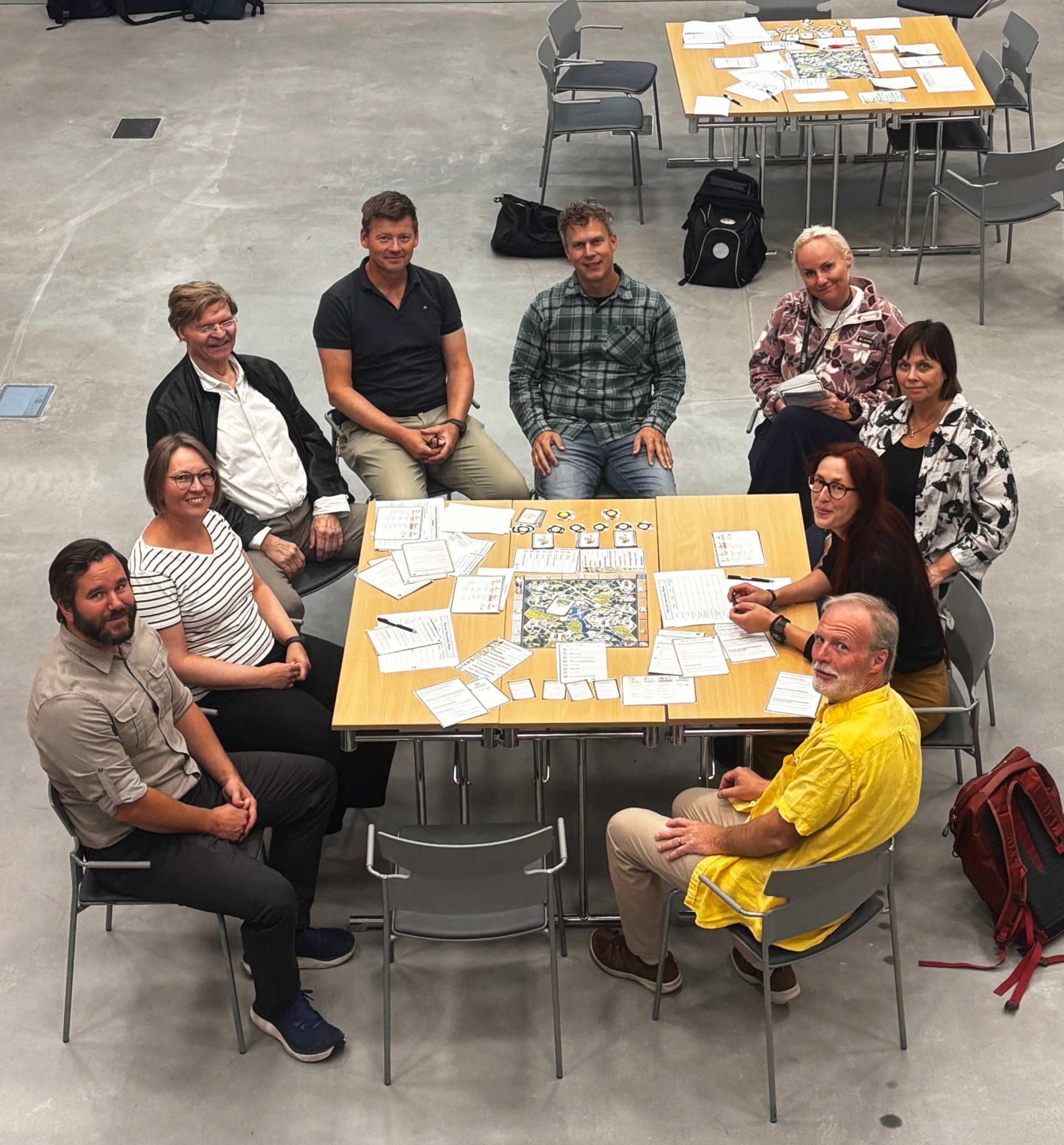
In a bunker housing the Centre for Prepardness and Crisis Management in Rena in Eastern Norway, 40 newly enrolled bachelor’s students in preparedness and crisis management from Inland Norway University are gathered. They make up the “crisis staff,” and in front of them lies a colourful board game – an advanced tool designed to train cooperation when it matters most. The scenario they must tackle together is heavy rainfall.
“The game is really about preventing societal collapse,” explains political scientist and game creator David Olsson from Karlstad University. “Whether the scenario is heavy rain, a heatwave, or a forest fire, the idea is the same. We want to demonstrate the entire chain of crisis management: prevention, response, and post-crisis learning. The goal is to develop a tool that can be used both in academia and by professionals.”
A Laboratory for Collaboration
The board game has been developed as part of the Interreg project Incredilab, which aims to strengthen cross-border climate adaptation. The project idea is simple yet demanding: to train people to collaborate across municipal and national borders before disaster strikes.
“Participants learn how, for example, municipalities can stand stronger together. Should they perhaps invest jointly, even if the preventive measures are implemented in only one municipality? This way, responsibility and benefits are shared,” says professor of information systems John Sören Pettersson at Karlstad University. The project is now about halfway through. “We already see that the exercises spark new ideas about how collaboration can work in practice.”
Students Stepping into Crisis Leader Roles
For the students, the game is an exercise in seeing the bigger picture. Line and Solveig, who have just navigated their fictive Swedish and Norwegian municipalities through a flood scenario, describe the experience as unusual but realistic:
“You get to test how it might actually be in real life – with the whole ‘before, during, and after’ way of thinking,” says Solveig. “I wish the game came in more levels – some simpler, some more advanced – so you could go deeper as you progress,” adds Line.
Their fellow student Vilde highlights how thought-provoking the experience was:
“It was more challenging than I expected. I had to see things from a broader perspective. It’s actually a very good introduction to how we need to think as preparedness professionals.”
Fresh Perspectives – New Ideas
According to Geir Ove Venemyr, a researcher in crisis management innovation at Inland Norway University and affiliated with Incredilab, the value lies in how the students approach the problem. “They come in without preconceived frameworks. They notice things we might overlook ourselves. Their input gives us ideas for how the game can be further developed – not only as a physical version but digitally as well.”
In the next phase, a digital game will be developed. The advantage is that exercises can be carried out simultaneously on both sides of the border, without everyone needing to meet physically. It will also make it possible to repeat the same scenario in exactly the same way multiple times.
Climate Knows No Borders
The project’s background is serious: increasingly extreme weather events. Floods, wildfires, and torrential rain do not stop at national borders. That means crisis preparedness must also become cross-border. For society to function in a crisis, it must work well in everyday life. Municipalities and emergency agencies need to know one another, speak the same language, and understand how collaboration will take place.
The project, running until 2026, is funded by the EU and involves researchers, municipalities, and IT environments in both Sweden and Norway.
The Training Ground of the Future
Back in Rena, the students wrap up the board game session with handing in written evaluations and pitching ideas for a digital version. Several volunteer to join the next test round.
Olsson, the game’s creator, is pleased with the input:
“My dream is for the game to be used both in education and by professional emergency actors – giving them a holistic understanding of crises and how they can be solved together.”