
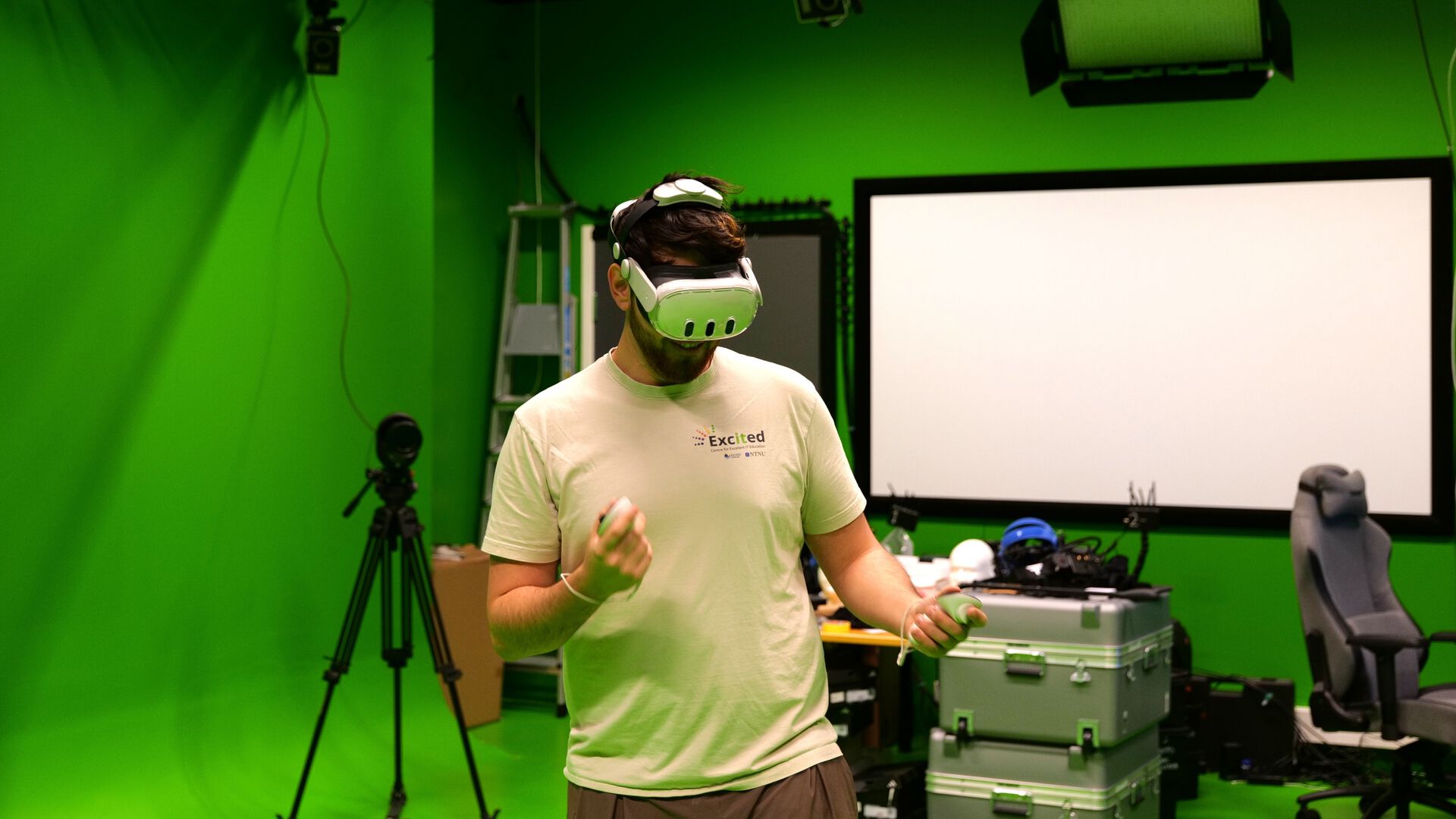
"If you've already done art or a bit of programming but still haven't figured out exactly what you want to specialise in, I think focusing on VR is a great opportunity. The VR platform is super interesting and very broad, making it applicable to many different areas," says Soellaart.
At the University of Inland Norway (INN), there are several opportunities to specialise in virtual reality and augmented reality (VR/AR), both as a bachelor's student in Game Art and Animation and Game Technology.
"And I think it's really cool that you can sort of learn everything from starting with creating games. The design principles will help you in creating any sort of app or software because it's really important to make something engaging," he continues.
We get to use incredible industry-leading software here at the Game School.
Aedan Soellaart
Soellaart goes on to explain how VR is used in various areas of healthcare, in both treatments for patients and in training for surgeons. There is also industry-level VR, where it is used for training personnel to use machinery, and it can even be used in education:
"We're actually developing a few simulations at the university – currently in the teacher education department. There are simulations of parent-teacher conferences, where future teachers can practice on scenarios that may be challenging."
When creating highly complex solutions in games and for different industries, there is naturally a lot of hardcore programming involved. This qualifies students to become programmers in pretty much any tech company after graduating.
.jpg)
At the Game School, there are always two paths to follow in game creation. You are not forced to do coding if you are an artist, or to do art if you are a coder. But there is still class-wide collaboration on projects.
"When I first started, like anyone starting a new sort of degree, I was super scared of what it would be like, how difficult it would be. I'd never once programmed in my entire life four years ago," says Soellaart.
He then underlines that the practical and project-based approach at the Game School as well as great guidance grom the teachers make it easy to learn whatever you are motivated for.