
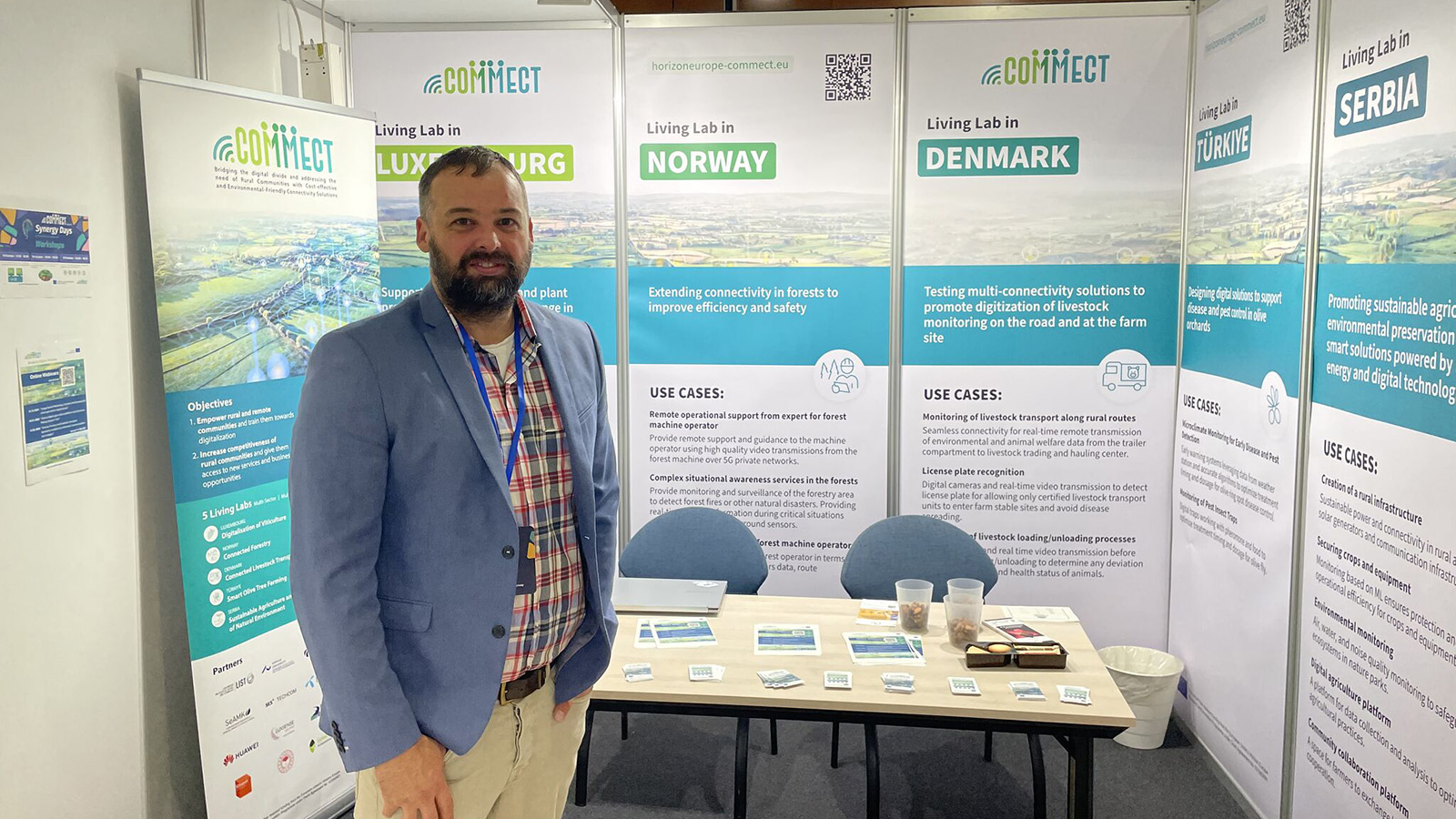
The Horizon Europe-funded COMMECT project has reached two years and is nearing its final year. The project, which has established five Living Labs both in and outside Europe, is researching and testing how technology can be used to develop businesses in rural and isolated areas. 'Klosser innovasjon' leads the Norwegian Living Lab, which is testing solutions for the forestry sector. The research centre CREDS is involved in various work packages and leads the effort to disseminate results.
Synergy Days is regarded as one of the most important conferences connecting digital innovators in Europe’s agri-food sector. At the conference in Barcelona, technologies and innovative business models were tested. There have been many interesting results so far in the project, particularly concerning the Norwegian Living Lab.
Developing a remote support system
One of many outcomes is the development of a remote support system for forestry machine operators. This system uses video streaming over portable 5G networks, which the operators take with them to worksites in remote areas. In this way, the forestry operators can receive real-time assistance from their managers or experts while working in areas without regular 4G or 5G coverage.
– The system makes logging more efficient, but it can also improve safety, says Gabriel Linton, CREDS researcher and participant in the project. He also notes that this type of solution could be applied to other industries, such as mining, or in any sector where people work in isolated areas.
Synergies in Barcelona
At Synergy Days, the COMMECT project held three workshops. The project has developed a decision support tool that can provide farmers with expert advice, which was demonstrated in one of the workshops. Another workshop focused on socioeconomic impact and business models. Here, discussions were held on how new business models developed within COMMECT could support local communities through a perspective on cooperative models.
– The aim of these models is to ensure that digital access is not just a technological solution but also economically sustainable and beneficial to local economies.
The project is crucial for creating lasting change and providing equal opportunities to those living in rural areas, adds Gabriel Linton. The final workshop focused on the approach of having five Living Labs across Europe.
20 partners
COMMECT is a collaboration between 20 partners from many different European countries. The various partners bring wide-ranging expertise, with partners such as Telenor providing technical expertise, while others focus on business and social aspects. CREDS and INN are responsible for sharing the project’s results and working on business models for the solutions.

– COMMECT aligns well with CREDS’ goal of promoting digitalisation for sustainability. It’s about ensuring that rural areas don’t fall behind – access to the digital world is crucial to prevent this, concludes Gabriel Linton.
Related links
Contact information

- gabriel.linton@inn.no
- Phone
- +47 62 59 79 12