

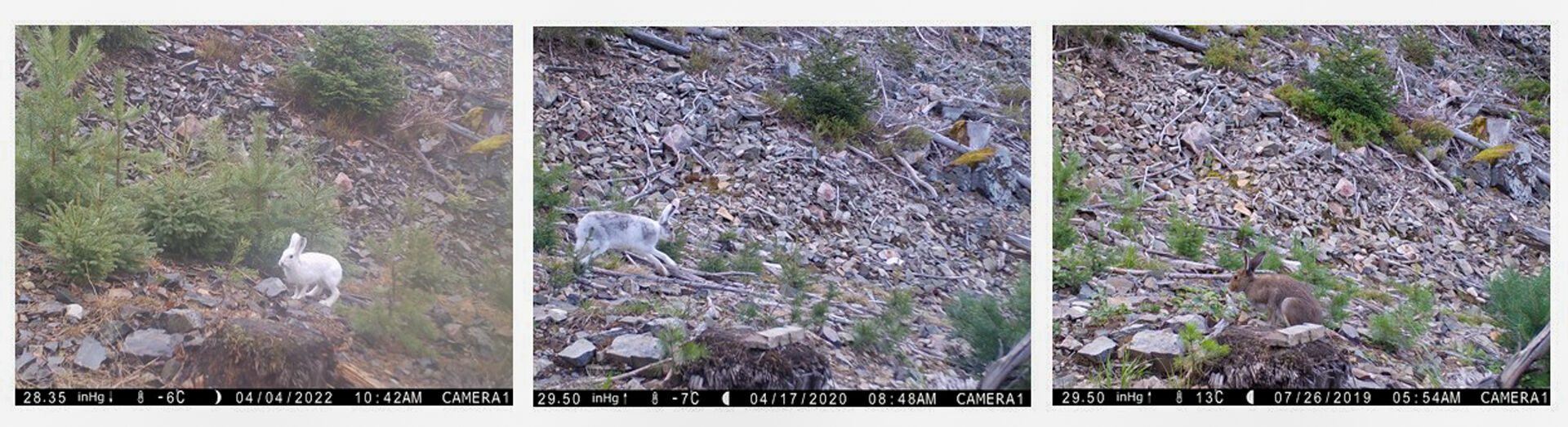
The mountain hare changes from winter white to summer brown. The goal of the hare is to blend in as much as possible with its surroundings.
For the first time in Norway, it has been documented that the hare cannot adapt as quickly as the climate changes.
– We investigated the correlation between shorter winter duration over the past 60 years and the timing of coat color change in hares. We found that areas experiencing the greatest decrease in number of days of snowcover during winter were the areas were hares had the wrong colour for the most days throughout the year, says Allan William Stokes.
Just before summer, he defended his doctoral thesis on this topic at Inland Norway University of Applied Sciences (INN University) – the first PhD on hares in Norway.
- Read the full dissertation of Allan William Stokes here
Plenty of photographic evidence

This research has been conducted in collaboration with the Norwegian Institute for Nature Research (NINA) and with Allan's supervisor, Simen Pedersen, associate professor at the Department of Forestry and Wildlife Management at the university, and a longtime hare researcher.
A significant part of the work involved classifying approximately 10,000 images of hares captured by NINA's 700 camera traps across large parts of Norway. These photos span over the last ten years.
– We have an enormous amount of data, and we are very pleased to have had access to these photos. It has been a massive task, and we have received help from students and interns who have been classifying all these photos, the two hare researchers explain.
With these photos, Allan has been able to directly study the hares passing the cameras in both summer and winter. One could assess the hare's coat colour and whether there was snow on the ground or not.
– Why do you think no one has written a doctoral thesis on this before?
– It would not have been possible to gather enough data to calculate the timing of coat changes across Norway using conventional techniques, for example, by capturing, marking and tracking individuals. The development of wildlife cameras makes collecting the data necessary for this type of study much easier, says the newly minted doctor.
Clearly demonstrates climate change
There is a wide variation in Norway in terms of how many days the hare has the wrong colour, as shown in the new doctoral thesis.
There are many areas that no longer have a continuous snow cover throughout the winter. Especially along the southern coast, hares have the wrong colour for long periods. In the inland areas and at higher altitudes, they have the wrong colour for the fewest days.

– We have suspected this, but this is the first time it has been documented precisely when this happens, and that we have seen this pattern, according to Simen Pedersen.
– What are the consequences of the hare not being able to keep up with climate change?
– We assume that if you are white on bare ground, you are more visible to predators and thus more vulnerable. We do not have specific numbers on this, but we have an ongoing marking project where we will examine survival rates based on coat colour, to determine this as well, he explains.
Is the hare able to adapt?

The mountain hare in Norway does not change the timing of its coat change as quickly as the climate changes.
But, there is hope for the hare in the future. Stokes explains that in Norway, we have a subspecies of mountain hare that possibly has adapted in ways worth noticing
–A hare called the heath hare changes to a blue-gray coat in winter instead of snow white. This adaptation is believed to be suited to milder winters with variable snow cover, as hares with this coat colour are more likely to be camouflaged in areas with limited snow cover.
There are 21 different species worldwide that change their coat from winter white to summer brown, and vice versa.
Researchers at INN University will further investigate whether hares are making behavioural adaptations to their new environment. Research by Simen Pedersen and colleagues from Scotland and the USA suggests that mismatched hares in Scotland do not make behavioural changes; they are not aware of their own colour. It is uncertain how applicable this finding is to Norwegian conditions.
– When it comes to climate change, it is possible that hares may adjust the timing of their coat change. But so far, we have found that hares do not adapt as quickly as the climate changes and winter becomes shorter, Pedersen explains.
– What does this research mean for your doctoral thesis, Allan?
– In the broader context, this research illustrates the likely impact of future climate change on many species, concludes Allan William Stokes.
Contact information:

- allan.stokes@inn.no
- Phone
- +47 61 28 74 22

- simen.pedersen@inn.no
- Phone
- +47 62 43 08 43