

There is far from enough money to meet the world's needs for humanitarian aid.
Many argue that current humanitarian principles provide insufficient guidance on how to allocate funds when resources are scarce and needs appear equally pressing in different situations.
Associate Professor Lars Christie at the Department of Law, Philosophy and International Studies aims to address this challenge.
– Should we prioritise solely based on need? What role should cost-effectiveness play? Should considerations of fairness be emphasised, even if it comes at the expense of efficiency, so that no groups are entirely deprioritised? These are some of the questions I have been pondering for a while, and I hope to answer them through this research, says Christie.
A great need for knowledge
Before joining the university, Lars Christie worked for many years at the Ministry of Foreign Affairs.
In this role, he travelled to countries like Iraq, Syria, Lebanon and Somalia and saw firsthand the challenges involved in distributing aid in conflict zones. During his work, he was struck by two things.
– One was how difficult the issues related to distributing scarce aid resources were. The other was that the prioritisation decisions of both donor countries and aid organisations could have been better justified, and that value conflicts should have been recognised more openly, he explains to inn.no.
In mid-October, the Research Council of Norway announced the allocation of NOK 156 million to new projects with significant potential to advance the research frontier in their fields, known as FRIPRO projects.
87 applications were assessed, and 16 received funding. One of the successful applications was Lars Christie’s.
– This funding allows for long-term work and supports an extended research stay abroad. It also enables us to invite representatives from academia, diplomacy and humanitarian organisations to meet and facilitate knowledge exchange between these professional groups, Christie says.
The ambition is to gather input and share research findings with donors and humanitarian organisations throughout the project.
Many contributors
Lars Christie will cooperate with international academic colleagues and practitioners and will be visiting scholar in the Department of Philosophy at the American University of Beirut.
– Beirut is also home to many key humanitarian organisations, and AUB collaborates with several of them. Additionally, this is a region where I have previously worked and can draw on an established network of contacts, he explains.
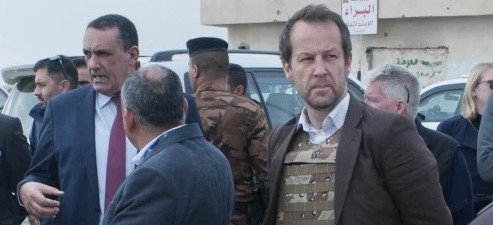
Christie will also cooperate with the Stockholm Centre for the Ethics of War and Peace, as well as an advisory group composed of skilled philosophers, diplomats, civil society representatives, and UN staff.
– Why is it important to research the ethical aspects of prioritisation in humanitarian aid?
– This is important because it sheds light on what constitutes good and bad justifications for resource allocation when aid organisations do not have enough for all those in need, says Lars Christie.
He also believes that current humanitarian policy is insufficiently informed by academic contributions from moral or political philosophy, which are necessary.
– The strategy documents underlying Norwegian humanitarian aid do not include this. Nor do the occasional reports commissioned by the Norwegian government from external experts. I doubt this is uniquely Norwegian, and I suspect the same weakness applies to other humanitarian donor countries. One reason may be that there is not enough normative research on precisely these questions. That is why I hope this project will be relevant, Lars Christie concludes.
Contact information:

- lars.christie@inn.no
- Phone
- +47 61 28 80 19