
Self-archiving of scholarly publications
To fulfill national guidelines and requirements from EU and the Research Council regarding open access to research, you are obliged to archive your scholarly publications in the Norwegian Resarch Information Repository (NVA)
All scholarly articles where employees at INN are authors or co-authors must be self-archived in the Norwegian Research Information Repository (NVA).
Uploading a version of the article to an open repository is thus an example of the so-called green route to Open Access. Read more about different forms of open publishing.
Which version of my article should I deposit?
- As a general rule, you should upload the author's accepted manuscript (AAM) version of the paper. The AAM is the version produced after it has passed peer review and been accepted for publication, but before the publisher applies copyediting, typesetting, or official branding.
- Articles that are published open access must also be self-archived. Does your article have a Creative Commons license, for example CC BY? Then you can upload the final published version in NVA.
The rights retention policy at University of Inland Norway gives researchers the right make the AAM available in NVA immediately.
Publishers' guidelines and copyright
The University Library is responsible for copyright clearance of publications uploaded to NVA. The University Library checks the uploaded article version. Publications are only made openly accessible if this can be done in accordance with the book publisher’s policy for self-archiving or INN’s right retention policy (that does not apply to books).
To track and check publishers copyright and self-archiving policies, use Open policy finder. The webpage provides information on embargo periods, CC licences, as well as guidelines for preprints and postprints. If you need help, please contact the library.
If your paper is not covered by the rights retention policy: SPARC and Creative Commons have developed author addenda that can be attached to publishing agreements. These can help you keep the right to make your work available online.
As the author, you retain the copyright to material deposited in NVA. Self-archiving your work does not affect your copyright or your ability to publish the material elsewhere.
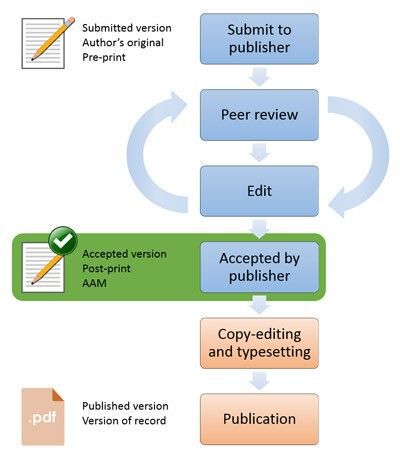
Further down this page, you can read more about the different versions of a scholarly article.
How to submit your article in NVA.
After publication, uploading the AAM in NVA. You have to be logged in to upload files.
Before uploading, you should add a cover page explaining that it is an AAM:
When uploading you set the CC license and apply an embargo.
The University Library is responsible for copyright clearance of publications uploaded to NVA.
Key concepts
Publications with an open licence can be made available in the repository in their published version. For publications without open access, it is usually the accepted version (AAM) that should be uploaded to NVA.
Submitted version (preprint)
The version of an article that is submitted to the publisher for publication, before it has been peer-reviewed. Many publishers allow this version (preprint) to be made available in open repositories.
Accepted version (postprint)
The accepted manuscript version, or author accepted manuscript (AAM), usually refers to the version of a scholarly article that has been fully revised after peer review and is the author’s final version (Final Draft Post Refereeing). This version will be identical in content to the published version, but lacks the publisher’s typesetting, layout, and design.
Published version (Version of Record)
The version that is published in the journal, the final version that has been fully formatted and proofread by the publisher. The publisher’s PDF with the publisher’s layout (logo, pagination, volume/issue information).
Embargo
The publisher may set an embargo period specifying how long it must take before an article can be made available in an open repository. The embargo can last from six to 36 months before the article can be made available in NVA.