
Bibliometric services at INN
The University library (UB) can be of assistance in performing bibliometric analyses.
What is bibliometry?
Bibliometry is a quantitative analysis of scientific publications. The method is used to quantify, assess and evaluate research activity through different parameters that measure productivity, impact and quality.
- Institutions can use these analyses for administrative and strategic purposes across multiple levels
- Citation analysis, an essential method in bibliometrics, allows researchers to quantify and make their own research impact visible. Citation analysis can also be used for thematic mapping of research distribution and patterns of research collaboration.
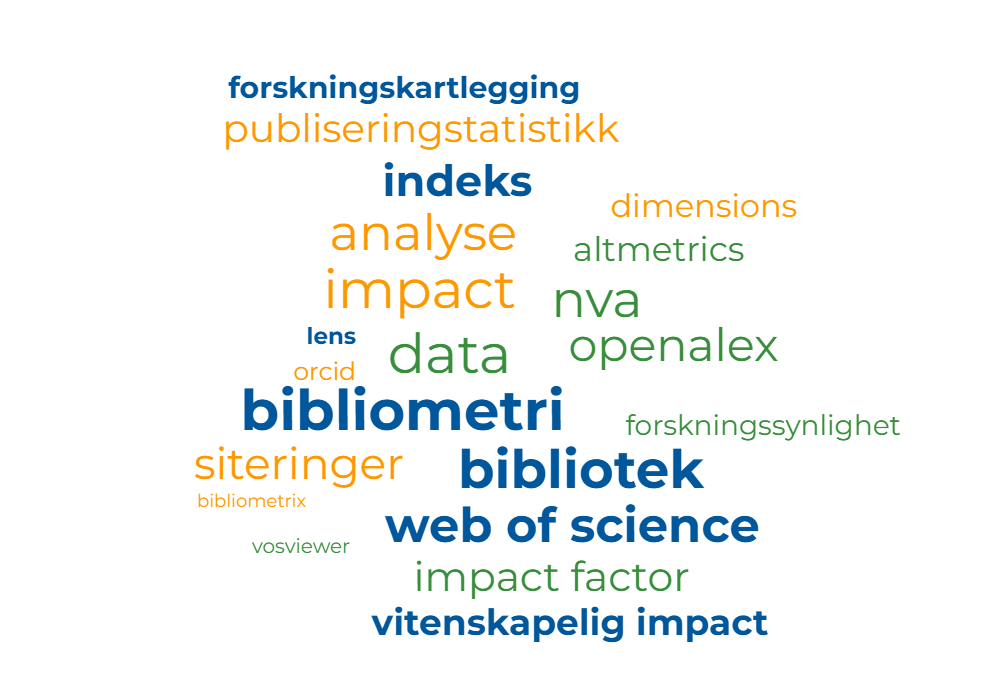
The University Library (UB) offers advice and conducts analyses of publication activity at INN.
- Academic publishing: UB provides reports based on the Norwegian Science Index (NVI) at the faculty and institute level. These data are extracted from the Norwegian Research Information Repository (NVA).
- Science mapping: UB offers mapping of specific fields of research or citation networks at the faculty level. These analyses are available upon request and subject to capacity.
- Courses and digital resources: UB offers courses and video resources on:
- Use of bibliometric databases and open-source tools for science mapping.
- Research visibility, researcher profiles and how to track your publication activities in various ways (i.e. in ORCID, Google Scholar, Web of Science, Scopus and NVA).
The courses can be requested.
Read more on Increase your visibility as a researcher.
Essential databases
- Web of Science – international multi-disciplinary citation database.
- Essential Science Indicator – statistics and data on academic publishing. Provides information on trends and impact for journals, countries, institutions and individuals. Based on citation data from Web of Science.
- OpenAlex – is an open and free-of-charge bibliographic database containing over 270M entries organizing scientific information such as publications, authors, institutions, disciplines and topics. The service offers an extensive dataset to explore links between research articles, citations and concepts/topics. More on the datamodel and subject categories at Open Alex.
- Scopus – is a large database with citations and abstracts of peer-reviewed literature in the fields of science, technology, medicine, social sciences and arts and humanities.
- Google Scholar – search engine for academic literature across all fields and publishing formats. Includes citation search.
- Dimensions – is a multi-disciplinary search engine containing citation data from CrossRef, along with other indicators from Altmetric (which tracks how research is mentioned and used in various sources on the internet).
- Lens.org – an open search engine for patents.
Bibliometric analysis tools
Examples of open tools to build and visualize bibliometric networks.
Bibliometric resources
Ball, R. (Ed.). (2021). Handbook bibliometrics. De Gruyter Saur. https://doi.org/10.1515/9783110646610
IATUL Special Interest Group for Metrics and Research Impact (2019). 12 Research Impact Things. https://iatulimpactthings.info/
Sugimoto, C., & Larivière, V. (2018). Measuring research: What everyone needs to know. Oxford University Press.
Sikt - Kunnskapsektorens tjenesteleverandør (2025). Bibliometri og bibliometriforum.
https://www.openscience.no/nib/bibliometriforum
Ungvarsky, J. (2024). Bibliometrics. EBSCO Research Starters. https://www.ebsco.com/research-starters/library-and-information-science/bibliometrics
Waltman, L. & Noyons, E. (2018). Bibliometrics for Research Management and Research Evaluation: a brief introduction. Center for Science and Technology Studies (CWTS), Leiden University. https://www.cwts.nl/pdf/CWTS_bibliometrics.pdf
Contact us
For questions related to bibliometrics, please contact

- randolf.mariano@inn.no
- Phone
- +47 62 43 02 41