
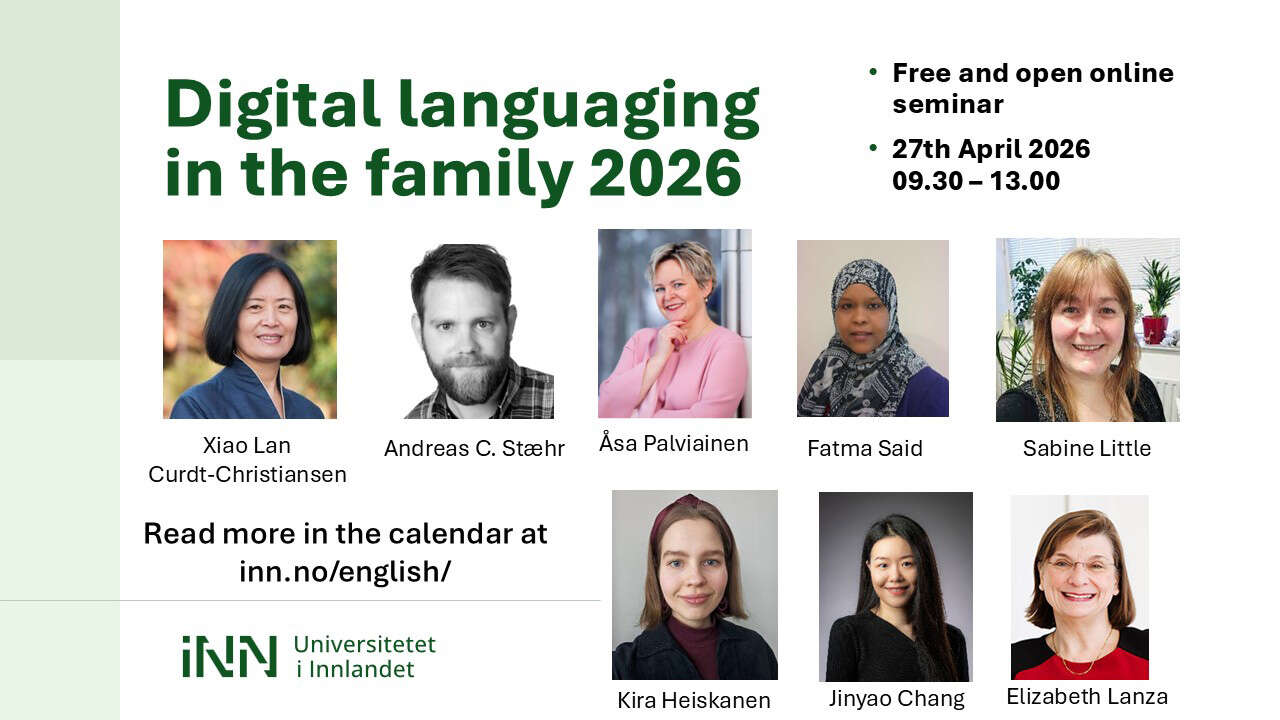
Digital practices are integrated into families’ everyday lives. In this seminar five empirical perspectives are presented to discuss the following questions: What heritage language practices to transnational families engage in in the digitally mediated communicative space? How do these practices lead to multimodal and multilingual literacy learning? What roles do parents play and how can research collaborate with them?
How does digital interaction affect intra- and intergenerational relationships? And how do parents engage in tracking and texting practices to monitor their children? To follow up the Digital languaging in the family seminar organized in September 2021, this event features some of the leading scholars in the field to present and discuss the newest developments in the study of digital language practices in multilingual families.
Program
09.30-09.40 Welcome, Kristin Vold Lexander, University of Inland Norway
09.40-10.10 Xiao-Lan Curdt-Christiansen and Jinyao Chang, University of Bath: Digitally Mediated Multilingual Literacy Practices in Chinese Transnational Families
10.10-10.40 Andreas C. Stæhr, University of Copenhagen: Tracking and texting as digital monitoring in the family: A framework for observational and communicative approaches
10.40-11.10 Åsa Palviainen & Kira Heiskanen, University of Jyväskylä: Digitally mediated family communication across generations: Insights from the XYZdigi project
11.10-11.25 Break
11.25-11.55 Fatma Said, Zayed University: Curating complexity: Parental pedagogical digital agency in home Arabic literacy development
11.55–12.25 Sabine Little, Sheffield University: "Traditional Tales, Untraditionally Told" - Combining digital storytelling and makerspace pedagogy to support heritage languages in public settings
12.25-12.45 Elizabeth Lanza, University of Oslo, discussant
12.45-13.00 Final discussion and closing
Abstracts
Xiao Lan Curdt-Christiansen and Jinyao Chang, University of Bath
Digitally Mediated Multilingual Literacy Practices in Chinese Transnational Families
The rapid development of digital media has enabled many migrant/transnational families and HL learners to increase their heritage language (HL) exposure and enrich their multilingual literacy practices. Yet little is known about the process and the ways in which digital media facilitate multilingual children’s literacy development. This study explores how multilingual children engage in digitally mediated literacy practices in family chats. The study is situated in the transnational context of the UK, in which transnational families often engage in multilingual practices with their family members close and far via digital devices such as WhatsApp and WeChat. Involving three transnational Chinese-English families, the study demonstrates that these digital platforms not only provide affordance for family communication, but also facilitate HL literacy development. Data sources include screenshots of multimodal WhatsApp/WeChat interactions, messages between members of the extended family, and children’s retrospective interviews. The findings suggest that digitally mediated family communication enhances multilingual children’s literacy practices through a variety of resources and multimodal possibilities. Within the digitally-mediated communicative space, family members engage in a range of practices, including sociocultural meaning-making, literacy practices, cultural positioning, and construction of linguistic identity.
Andreas C. Stæhr, University of Copenhagen
Tracking and texting as digital monitoring in the family: A framework for observational and communicative approaches
In this presentation I examine how digital monitoring practices through texting and tracking are constructed, practiced, and reflected upon by parents and teenagers in Danish families. All the participating families engage in monitoring practices, but their approaches differ between observational (tracking), communicative (texting) or hybrid strategies. The parents’ choices between these approaches (or to opt out of tracking app use) are tied to three ideological positions on tracking apps: (1) a common family practice, (2) a necessary evil, and (3) a moral wrong. Interactional analysis of parent-teen texting and interviews reveals that parents’ insights into teenagers’ activities and social practices vary depending on whether an observational or a communicative approach is employed. Based on these findings, and building on theories of parental monitoring and surveillance, I propose a conceptual framework distinguishing observational monitoring and communicative monitoring, offering a nuanced lens to capture and explain the full range of monitoring practices and their interplay in contemporary family life.
Åsa Palviainen & Kira Heiskanen, University of Jyväskylä
Digitally mediated family communication across generations: Insights from the XYZdigi project
This paper presents the Finnish project Generation X, Y and Z and digital language practices: Intra- and intergenerational meaning-making, adaptation and attitudes (XYZdigi), which commenced in January 2025. The project’s design and rationale will be introduced by the principal investigator, Palviainen. PhD student Heiskanen will then present preliminary findings from her fieldwork, focusing on how Finland-Swedes discuss their own and their family members’ digital language practices. Particular attention is given to linguistic and communicative practices in mobile instant messaging applications. The data consist of semi-structured interviews with young (approximately 20-year-old) and middle-aged (approximately 40–50-year-old) Finland-Swedish women who primarily use WhatsApp to maintain digital contact with family members living both nearby and at a distance.
Fatma Said, Zayed University
Curating complexity: Parental pedagogical digital agency in home Arabic literacy development
Digital technologies have transformed how transnational multilingual families learn and use their multiple and heritage languages (HL). This paper examines the everyday literacy practices of Arabic-speaking multilingual families in the UK. Using a linguistic and digital ethnographic approach, it explores how digital tools are adopted in the home and how they contribute to multilingual and multimodal literacy development. Data were generated through interviews, surveys, field notes, digital diary entries, and recordings of family interactions. The analysis shows that digital technologies support HL literacy only when parents actively guide their use through what is conceptualised here as “parental pedagogical digital agency”. This involves parents’ thoughtful selection of resources, regulation of access, and ongoing negotiation with children’s interests and preferences. Without such mediation, technology tends to offer surface-level exposure that supports cultural connection and identity building but does not lead to sustained development of literacy skills. At the same time, children are not passive users; they exercise agency in navigating digital spaces and, in doing so, influence parental decisions and family language practices. The paper concludes by arguing that effective digital support for heritage and language learning must prioritise parental guidance and pedagogical support rather than relying solely on access to technology.
Sabine Little, University of Sheffield
"Traditional Tales, Untraditionally Told" - Combining digital storytelling and makerspace pedagogy to support heritage languages in public settings
The "Traditional Tales, Untraditionally Told" project focuses on creating resources that enable teachers, librarians, and other practitioners to advance their skills in two specific areas: on the one hand, developing makerspace pedagogy, and on the other, considering, working with, and valuing children's home and heritage languages. Working with four schools and four library settings, research went hand-in-hand with creating pedagogical materials to support a website roll-out. The dual focus proved to be effective in drawing in project partners who had an interest in either area, enhancing catchment and reach of the work. Teachers reported increased confidence, and parents highlighted how the project enabled them to find and pursue new ways to share the heritage language with their children.
Registration
The seminar is online, free and open to all.
Contact person

- kristin.lexander@inn.no